Deploying commercial electronic shelf labels (ESLs) requires engineering four interdependent layers before ordering hardware: the milliampere-second (mAs) battery budget of bistable E Ink panels, sub-zero electrolyte behavior in chilled and frozen cases, asymmetric point-of-sale (POS) price-synchronization gating under weights-and-measures rules, and physical shelf-edge rail compatibility across steel gondolas, wire racks, and wet produce tables. Treating digital price tags retail rollouts as simple screen swaps leads to premature coin-cell exhaustion from unbudgeted pick-to-light LED flashing, unreadable ghosted displays below 0 °C, checkout overcharge citations during promotional markups, and broken plastic tag mounts along narrow stocking aisles.
Store owners, retail buyers, and facility managers planning a shelf-edge automation project should copy exact tag dimensions, nominal milliamp-hour (mAh) battery ratings, radio-frequency (RF) channel allocations, and operating temperature ranges directly from the manufacturer cut sheet and their own floor survey. Pair the hardware and synchronization rules below with our operational checklist before a shop adds self-service inside the retail technology hub so checkout exception handling, restocking workflows, and maintenance logs are settled before installation begins.
| ESL Tag Class & Typical Diagonal Size | E Ink Display Chemistry & Temperature Rating | Typical Battery Architecture & Usable Budget | Full-Screen Refresh Duration & Energy Draw | Typical Unit Hardware Cost (USD) | Primary Retail Gondola / Fixture Application |
|---|---|---|---|---|---|
1. Small-to-Midsize Ambient SKU Tags (1.6 in., 2.13 in., 2.2 in., 2.6 in., 2.9 in.) |
E Ink Spectra 3100 (3-Color BWR/BWY or 4-Color BWRY); rated 0 °C to +40 °C (+32 °F to +104 °F). |
2 × CR2450 Li-MnO2 coin cells (1,100–1,200 mAh nominal; 950–1,000 mAh net usable) or 600–1,200 mAh pouch cell. |
15 to 25 s waveform at ±15 V; draws 8–18 mA peak (40–90 mAs or 0.011–0.025 mAh per update). |
USD 4.50 to USD 8.50 per tag (volume & transceiver dependent). |
Center-store dry grocery, pharmacy OTC, hardware pegs, health and beauty 1.25 in. C-channel shelves. |
2. Dedicated Sub-Zero Freezer Tags (2.1 in., 2.6 in., 2.9 in.) |
Low-viscosity monochrome (Black-White) E Ink with NTC thermistor LUT; rated -25 °C to 0 °C (-13 °F to +32 °F). |
Dual low-ESR cold-electrolyte CR2450D / CR2450HR cells or lithium thionyl chloride pack in IP67/IP68 welded housing. |
3 to 8 s temperature-compensated monochrome pulse; low-ESR chemistry prevents < 2.2 V MCU brownout. |
USD 9.00 to USD 15.00 per tag. |
Walk-in reach-in freezers, ice-cream glass-door merchandisers, frozen meat and seafood bunkers. |
3. Large-Format Multi-SKU / Produce / Endcap Tags (4.2 in., 5.8 in., 7.5 in.) |
E Ink Spectra 3100 3/4-Color; 0 °C to +40 °C (IP68 washdown frames for wet produce/deli zones). |
3 to 4 × CR2450 cells (1,650–2,400 mAh nominal) or replaceable battery cassettes for larger backplanes. |
18 to 28 s refresh; larger capacitive backplane consumes 2.0 to 3.5× more charge per update (0.030–0.075 mAh). |
USD 18.00 to USD 45.00 per tag. |
Bulk produce tables, bakery baskets, butcher/deli service cases, promotional endcaps, multi-item wine matrices. |
1. E Ink Display Physics, Refresh Power Budgets, and 5-Year Coin-Cell Lifespan Modeling
Commercial electronic shelf labels—deployed across platforms such as VusionGroup (SES-imagotag V-Series), SoluM (Newton and Newton Pro), Hanshow (Nebular and Stellar Pro), and Pricer (SmartTAG Power)—combine bistable electrophoretic electronic paper (E Ink) with an ultra-low-power system-on-chip (SoC) radio or optical infrared receiver powered by primary lithium manganese dioxide (Li-MnO2) batteries. Vendor brochures routinely headline a "5- to 7-year battery lifespan", but whether a tag reaches year five or dies in year two depends entirely on the store’s daily refresh waveform count, wake-on-radio polling interval, pick-to-light LED flash duration, and aisle temperature.
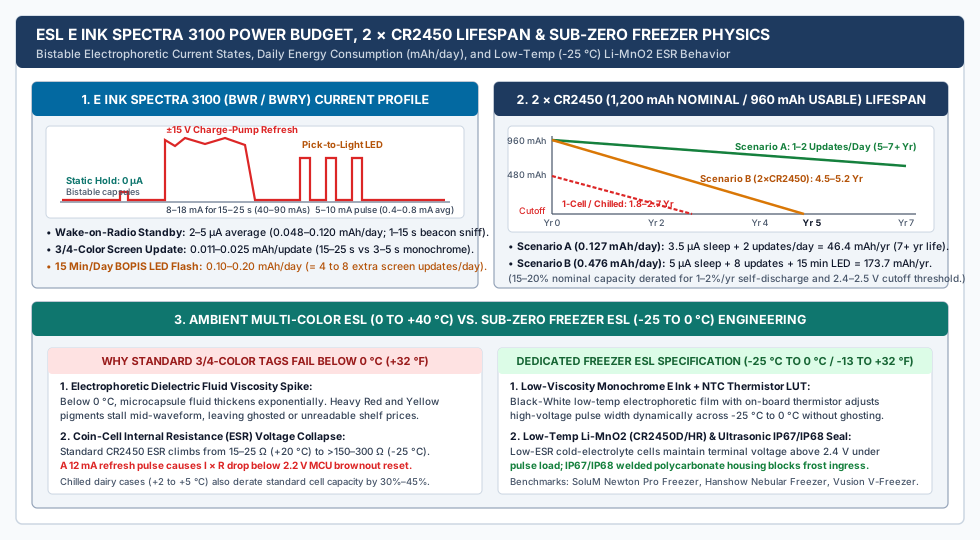
Bistable Electrophoretic Current States (0 µA Static vs. ±15 V Refresh Waveforms)
Unlike liquid-crystal (LCD) or light-emitting diode (LED) shelf strips that require continuous AC/DC busbars along every gondola shelf, E Ink Spectra 3100 electronic paper is bistable:
- Static Image Holding Power (
0 µA): Charged pigment microcapsules—containing negatively and positively charged Black, White, and Red or Yellow (3-color) or Black, White, Red, and Yellow (4-color BWRY) particles suspended in clear dielectric fluid—remain mechanically stable once positioned at the viewing surface. Retaining crisp text, unit-price blocks, QR codes, and scannable 1D GS1 barcodes consumes zero battery current (0 µA) between updates. - Sleep and Wake-on-Radio Polling Current (
2 to 5 µAAverage): Between price updates, the tag’s microcontroller remains in deep sleep and wakes briefly every1 to 15 seconds(configured by latency tier) to sniff for a synchronized RF beacon or optical infrared wake-up preamble. This background heartbeat draws2 to 5 µAcontinuously, consuming0.048 to 0.120 mAh/day(17.5 to 43.8 mAh/year) even if not a single price changes all year. - Full-Screen Electrophoretic Refresh Energy (
40 to 90 mAsper Update): While monochrome Black-White E Ink panels refresh in3 to 5 seconds,3-colorand4-color E Ink Spectra 3100displays require15 to 25 secondsper full-screen update. An integrated on-tag DC-DC charge pump steps the3.0 Vcoin-cell supply up to alternating±15 Vhigh-voltage pulses that first clear residual image ghosting (causing the characteristic black-white-red inversion flash) and then sequentially separate heavy red and yellow pigment species with different electrophoretic mobilities. Receiving the compressed bitmap payload over RF and driving the±15 Vcharge pump draws8 to 18 mApeak for several seconds, consuming40 to 90 milliampere-seconds (mAs)—equivalent to0.011 to 0.025 mAhper full screen refresh on a2.1 to 2.9 in.tag. - Pick-to-Light LED Flashing Drain (
5 to 10 mAPulse /0.4 to 0.8 mAActive Average): High-visibility RGB LEDs integrated into the tag bezel speed up online order fulfillment (BOPIS) and night-crew restocking. Each50 to 100 msLED pulse draws5 to 10 mA(averaging0.4 to 0.8 mAacross a1 to 2 secondblink duty cycle). Fifteen minutes of cumulative LED flashing per day on a fast-moving SKU consumes0.10 to 0.20 mAh/day(36.5 to 73.0 mAh/year)—burning the exact same battery capacity as 4 to 8 additional full-screen E Ink updates every day.
Worked Battery Lifespan Calculation: 2 × CR2450 Coin-Cell Budget
Standard 1.6 in. to 2.9 in. ambient tags use two parallel CR2450 Li-MnO2 coin cells (550 to 600 mAh per cell = 1,100 to 1,200 mAh nominal at 3.0 V) or a sealed pouch cell (600 to 1,200 mAh). Over a 5-year service horizon, approximately 15% to 20% of nominal capacity is lost to intrinsic Li-MnO2 self-discharge (1% to 2% per year) and low-voltage charge-pump cutoff protection (tags flag a low-battery replacement alert at 2.4 to 2.5 V), leaving 950 to 1,000 mAh of net usable capacity (or ~480 mAh usable on compact single-cell 600 mAh tags):
- Scenario A — Standard Grocery or Specialty Shop (
1 to 2 Updates/Day, Minimal LED Use):- Daily Draw: Wake polling (
3.5 µA × 24 h = 0.084 mAh/day) +2full refreshes/day (2 × 0.020 mAh = 0.040 mAh/day) +30 sweekly restock LED check (0.003 mAh/day) =0.127 mAh/day(46.4 mAh/year). - Projected Lifespan: On a
960 mAhusable2 × CR2450pack, theoretical charge life exceeds20 years, meaning the tag easily achieves its5- to 7+ yearrated lifespan (3,650 to 5,110 total updates), bounded primarily by calendar electrolyte aging. Even a compact480 mAhusable single-cell tag lasts8 to 10 yearsunder this light duty cycle.
- Daily Draw: Wake polling (
- Scenario B — Aggressive Dynamic Pricing + Heavy BOPIS Pick-to-Light (
8 Updates/Day+15 Min/DayLED Flash):- Daily Draw: Fast wake polling (
5.0 µA × 24 h = 0.120 mAh/day) +8full refreshes/day (8 × 0.022 mAh = 0.176 mAh/day) +15 min/dayLED flashing at0.6 mAaverage (0.150 mAh/day) + bidirectional status/ACK telemetry (0.030 mAh/day) =0.476 mAh/day(173.7 mAh/year). - Projected Lifespan: On a single-cell
600 mAh(480 mAhusable) tag, battery life collapses to2.7 years. On a2 × CR2450(960 mAhusable) pack, pulse-load voltage droop compresses room-temperature service life to4.5 to 5.2 years—and down to1.8 to 2.8 yearsif that same tag is mounted inside a chilled+2 to +5 °C(+35 to +41 °F) dairy or beverage case where cold electrolyte derates effective capacity by30% to 45%.
- Daily Draw: Fast wake polling (
BOPIS Fulfillment Integration: If your store uses ESL pick-to-light LEDs to guide staff pulling prepaid online baskets for lobby pickup cabinets or backroom staging shelves, restrict LED flash timeouts to
15 to 30 secondsper pick and coordinate the fulfillment path with our guides on BOPIS retail: in-store pickup staging racks, workflow, and ADA signage and collection lockers and why the cabinet is not the order system.
Sub-Zero Freezer ESL Engineering (-25 °C to 0 °C Failure Modes & IP68 Seals)
Never mount a standard 0 °C to +40 °C 3-color or 4-color ESL tag inside a walk-in or reach-in freezer (-25 °C to 0 °C / -13 °F to +32 °F). Below freezing, standard tags fail through two distinct physical mechanisms:
- Electrophoretic Fluid Viscosity & Pigment Stalling: Below
0 °C(32 °F), the dielectric suspending fluid inside multi-color microcapsules thickens exponentially. Heavy red and yellow pigment particles cannot complete their electrophoretic migration within the±15 Vpulse window, leaving washed-out, ghosted, or half-updated prices on the freezer rail. Dedicated freezer ESLs (SoluM Newton Pro Freezer,Hanshow Nebular Freezer,VusionGroup V-Freezer) replace multi-color film with a low-viscosity monochrome (Black-White) electrophoretic panel governed by an internal negative-temperature-coefficient (NTC) thermistor and temperature-compensated waveform lookup table (LUT). - Coin-Cell Equivalent Series Resistance (
ESR) Spike & MCU Brownout: At+20 °C, a standardCR2450 Li-MnO2coin cell exhibits an internalESRof15 to 25 Ω. At-25 °C(-13 °F), lithium-ion diffusion slows sharply and internalESRspikes above150 to 300 Ω. When the tag initiates a12 mA(0.012 A) screen refresh pulse, Ohm’s law internal voltage drop (V_drop = I × R = 0.012 A × 200 Ω = 2.4 V) drags terminal voltage below the2.2 Vmicrocontroller brownout threshold, forcing the tag into a continuous reboot loop mid-update. Dedicated freezer tags use low-temperature electrolyte cells (CR2450D / CR2450HRor lithium thionyl chloride / low-ESR pouch cells) sealed inside ultrasonic-welded IEC 60529 IP67 or IP68 polycarbonate housings so humid aisle air entering an open freezer door cannot condense and freeze across the PCB.
2. Wireless Gateway Topologies (2.4 GHz, Sub-1 GHz, and Optical IR) & PoE Network Planning
Every electronic shelf label communicates through ceiling- or wall-mounted transceivers (gateways or access points) powered via Power over Ethernet (IEEE 802.3af PoE, 15.4 W maximum port budget, typically drawing 4 to 9 W per gateway). Choosing between the three commercial physical-layer (PHY) architectures dictates how many ceiling drops your electrician must pull and how the system behaves around steel gondolas and store Wi-Fi.
| Wireless PHY Modality & Representative Platforms | Indoor Coverage Radius & Floor Area per Gateway | Throughput Speed & Tag Capacity per AP | RF Coexistence & Store Propagation Characteristics |
|---|---|---|---|
1. 2.4 GHz Proprietary ESL RF / BLE 5.0+ / IEEE 802.15.4 (VusionGroup BLE / Meraki / Aruba AP, SoluM Newton Gateway, Hanshow HS-AP Gen3) |
15 to 25 m (50 to 80 ft) radius; covers 700 to 1,800 m² (7,500 to 19,000 sq ft). Minimum 2 APs recommended for small-shop overlap. |
20,000 to 60,000 updates/hour per AP; manages 5,000 to 15,000 tags per gateway. |
Shares 2.400–2.4835 GHz ISM band with IEEE 802.11 Wi-Fi. Must pin ESL channels in guard bands (802.15.4 Ch 15, 20, 25, 26) between Wi-Fi Channels 1, 6, and 11 to avoid retry battery drain. |
2. Sub-1 GHz Proprietary RF (433 MHz / 868 MHz EU / 902–928 MHz US FCC ISM Band) |
30 to 50 m (100 to 165 ft) radius; covers 2,500 to 7,500 m² (27,000 to 80,000 sq ft). |
3,000 to 10,000 graphical updates/hour per gateway due to narrower channel bandwidth. |
Superior diffraction around heavy steel gondola uprights and metallized cooler glass; zero 2.4 GHz Wi-Fi interference. Slower full-store batch image updates. |
3. Diffuse Optical Infrared (Near-IR 850–900 nm OWC) (Pricer Plaza / Base Station with daisy-chained ceiling optical transceivers) |
9 to 15 m (30 to 50 ft) radius per optical transceiver (250 to 700 m² per transceiver; 8–12 transceivers per base station). |
30,000+ updates/hour per base station; sub-second (< 1 s) pick-to-light LED trigger latency. |
Zero RF emission or Wi-Fi/BLE clash; bounces diffuse IR light off white ceilings and floors. Requires clear overhead sightlines so hanging promotional banners do not cast optical shadows. |
2.4 GHz Wi-Fi Guard-Band Coexistence and Isolated VLAN Segmentation
In 2.4 GHz deployments governed by IEEE Std 802.15.4 or Bluetooth Low Energy (BLE 5.0+), uncoordinated store Wi-Fi access points are the single largest hidden cause of shortened ESL battery life. When a store’s 2.4 GHz Wi-Fi network operates on wide 40 MHz channels or auto-hops across the band, high-power Wi-Fi bursts collide with low-power ESL acknowledgment packets. Each failed packet forces the ESL tag to keep its 10 to 15 mA radio transceiver awake for repeated retransmissions, multiplying daily RF energy draw by 3× to 5×.
To prevent packet collisions and secure the retail network:
- Pin
2.4 GHzWi-Fi to20 MHzChannels1, 6, and 11: Lock the store’s2.4 GHzWi-Fi APs strictly to20 MHzchannel widths on non-overlapping center frequencies (2412 MHz,2437 MHz, and2462 MHz), and assign the ESL gateways to the inter-channel guard bands (such asIEEE 802.15.4Channels15 [2425 MHz],20 [2450 MHz],25 [2475 MHz], and26 [2480 MHz]). - Deploy Minimum 2 PoE Gateways for Redundancy: Even if a single
2.4 GHzgateway’s15 to 25 m(50 to 80 ft) radius theoretically covers a2,500 sq ftshop, steel gondola shelving and walk-in cooler walls create localized multipath nulls. Installing at least two ceiling PoE gateways on opposite diagonals ensures that every tag has a secondary beacon path if one gateway port resets or an aisle endcap blocks line of sight. - Segmented IoT VLAN Backhaul: Terminate the ceiling Cat6 PoE drops onto an isolated Retail IoT VLAN—the same network segmentation principle detailed in our guide to smart vending machines: retail footprint, power, ADA, and network site prep—allowing outbound
TCP port 443(TLS 1.2/1.3) andUDP port 123(NTP) to the ESL middleware while blocking lateral access to POS cardholder databases.
3. POS/ERP Synchronization and NIST Handbook 130 Price-Verification Compliance
An electronic shelf label system is legally a metrology display governed by state and municipal weights-and-measures enforcement. Across the United States, inspectors audit retail checkout accuracy using NIST Handbook 130 (Uniform Laws and Regulations in the Areas of Legal Metrology and Engine Fuel Quality, Section V: Examination Procedure for Price Verification).
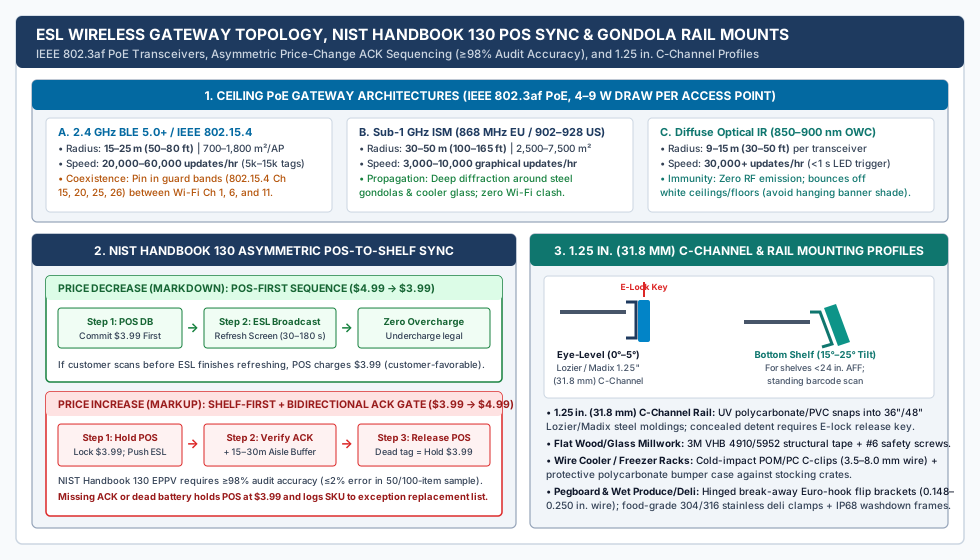
NIST Handbook 130 (98% Audit Accuracy Threshold & Strict-Liability Overcharges)
Under the NIST Handbook 130 Examination Procedure for Price Verification (EPPV), weights-and-measures inspectors pull a randomized sample of 50 items (or 100 items in larger stores) from the sales floor and scan them at the point-of-sale register:
- Maximum
2%Error Tolerance (≥ 98%Minimum Accuracy): A store fails the official inspection if more than2%of the sampled items (more than 1 item in a 50-item sample, ormore than 2 items in a 100-item sample) exhibit a discrepancy between the posted shelf tag and the POS checkout register. - Strict Liability on Overcharges: While an undercharge (where the checkout register charges less than the shelf tag) is recorded by auditors, state and municipal consumer-protection statutes treat any overcharge (where the POS scanner charges more than the posted shelf price) as an actionable violation subject to per-item civil fines, mandatory price-refund penalties, and repeat compliance inspections.
Asymmetric POS-First vs. Shelf-First + ACK Sequencing
Because wireless ESL gateways queue updates in batches (30 to 180 seconds total propagation and 15 to 25 seconds E Ink waveform rendering) and individual tags can fail to update if a battery dies or a shopper’s cart knocks a tag off the shelf, your POS-to-ESL middleware connector must enforce asymmetric directional sequencing:
- Price Decrease (Promotional Markdown or Clearance: e.g.,
USD 4.99 → USD 3.99) —POS-First Rule:- Step 1: The ERP/POS middleware commits the lower
USD 3.99promotional price to the POS checkout scanner database immediately. - Step 2: The middleware transmits the
USD 3.99bitmap to the ceiling PoE gateway and queues the wireless ESL screen refresh. - Compliance Outcome: If a customer picks up the item during the
60-secondradio queue window while the shelf tag still displaysUSD 4.99, the checkout register rings upUSD 3.99. The shopper receives a lower price than advertised (a permissible undercharge), creating zero overcharge liability.
- Step 1: The ERP/POS middleware commits the lower
- Price Increase (Promo Expiration or Inflation Markup: e.g.,
USD 3.99 → USD 4.99) —Shelf-First + Bidirectional ACK Gate:- Step 1: When raising a price from
USD 3.99toUSD 4.99, the middleware locks the POS checkout scanner at the lowerUSD 3.99price and transmits the newUSD 4.99bitmap to the ESL tag first. - Step 2: The ESL tag wakes, completes its
20-secondelectrophoretic refresh, verifies its internal display driver status, and transmits a cryptographic bidirectional acknowledgment (ACK) back through the PoE gateway to the middleware. - Step 3: Only after the middleware logs a positive
ACKreceipt—plus a configurable15- to 30-minutein-aisle shopper transit buffer (or by scheduling all price increases strictly outside open store hours)—does the middleware release the higherUSD 4.99price to the POS register. - Exception Handling for Dead or Missing Tags: If a tag fails to return an
ACKafter3gateway retry cycles (due to a depleted battery, RF shadow, or smashed screen), the middleware holds the POS scanner price atUSD 3.99and pushes the SKU into the morning manager’s Unacknowledged Tag Exception Queue so floor staff can swap the physical tag before the price increase takes effect.
- Step 1: When raising a price from
4. ESL Rail Mounting Types & Gondola Compatibility (1.25 in. C-Channel, Wire, Peg, and Wet Zones)
Roughly 12% to 18% of a first-time ESL hardware budget goes into extruded polymer mounting rails, clip adapters, protective bumper frames, and anti-theft locks. Ordering a single universal rail profile without auditing every fixture type on the sales floor leaves tags dangling from wire cooler racks or snapping off when grazed by stocking carts.
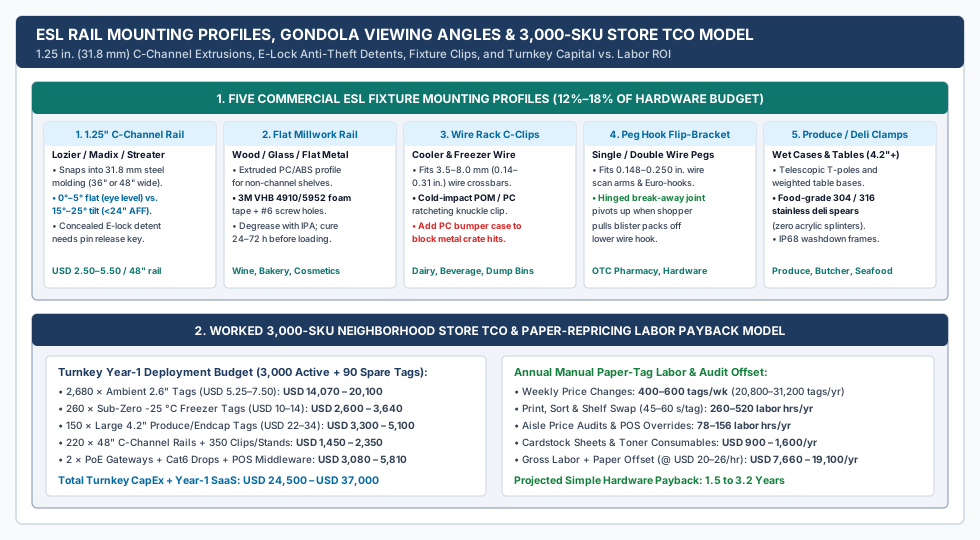
| ESL Rail Mounting Type | Compatible Store Fixture & Shelf Geometry | Extrusion Material & Viewing Ergonomics | Anti-Theft Locking & Mechanical Protection |
|---|---|---|---|
1. Standard 1.25 in. (31.8 mm) C-Channel Snap-In Rail |
North American rolled-steel gondola shelves (Lozier, Madix, Streater, Syndicate) with 1-1/4 in. front price moldings (36 in. / 914 mm or 48 in. / 1,219 mm lengths). |
Co-extruded UV-stabilized polycarbonate (PC) or high-impact rigid PVC. Rear spring lip snaps in tool-free. Flat (0°–5°) for eye level; angled (15°–25°) for bottom shelves < 24 in. AFF. |
Concealed internal detent track (E-lock / T-track) blocks sliding or prying; staff insert a narrow mechanical release key (pin tool) into the top seam to unlock. |
| 2. Adhesive-Backed / Screw-Mount Flat Surface Rail | Custom timber millwork, wine racks, bakery shelving, glass cosmetic counters, or flat-front metal shelves lacking a 1.25 in. C-channel. |
Extruded PC/ABS profile backed with closed-cell acrylic structural foam tape (3M VHB 4910/5952) plus countersunk #6 pan-head screw holes for oiled/rough wood. |
Same locked front E-lock channel; requires isopropyl alcohol degreasing and 24–72 hour VHB cure time before hanging heavy 4.2 in.+ tags. |
| 3. Wire Basket & Cooler Shelf Clip Adapters | Epoxy-coated wire cooler shelves, freezer baskets, and dump bins (3.5 to 8.0 mm / 0.14 to 0.31 in. wire rod diameter). |
Cold-impact polyacetal (POM) or polycarbonate C-clips and hinged knuckle clamps snapping over horizontal crossbars (individual holders or continuous 36/48 in. rails). |
Ratcheting rear wire lock clip paired with an enclosed polycarbonate bumper case to shield the E Ink glass lens from metal milk crates. |
| 4. Pegboard / Slatwall Euro-Hook Flip-Up Brackets | Single-wire or double-wire peg hooks (0.148 to 0.250 in. wire diameter) for hardware blister packs, electronics, and pharmacy pegs. |
Snap-on T-bridge or hinged flip-up adapter mounted to the upper scan-arm tip or directly onto a single-wire hook. | Hinged break-away knuckle pivots upward when a customer pulls merchandise off the lower wire, preventing snapped clips or bent peg hooks. |
| 5. Produce, Bakery & Deli T-Stands / Stainless Clamps | Slanted produce tables, wicker bread baskets, ice beds, and butcher/deli service cases holding 4.2 in. to 7.5 in. tags. |
Height-adjustable telescopic T-poles, weighted bases, or food-grade 304/316 stainless-steel pan clamps and deli spears. |
Enclosed IP68 washdown frames; specify 304/316 stainless spears rather than brittle acrylic that could splinter into open food pans. |
Ergonomic Viewing Tilt (0°–5° Eye Level vs. 15°–25° Bottom Shelf) and Washdown Durability
Unlike backlit LCD screens, electrophoretic E Ink panels rely on ambient store lighting reflected off the white titanium-dioxide pigment layer. Mounting a flat 0° rail on a bottom gondola shelf (6 to 18 in. above the finish floor) places the tag at an extreme grazing angle where overhead fluorescent or LED aisle fixtures cast glare across the lens and hand-held barcode scanners struggle to read the tag’s QR/EAN code. Specify 15° to 25° upward-tilted C-channel rails on the lowest two shelf levels (below 24 in. AFF) and 0° to 5° flat rails from waist height to eye level (30 to 66 in. AFF).
In wet produce misting zones, floral coolers, and butcher counters, pair IP68-rated tags with chemical-resistant polycarbonate rails and elastomer bumper guards that tolerate quaternary ammonium sanitizers and daily wiping—see our material durability guide on busy-room finishes: washing, wear and the day you replace them. When retrofitting rails and pulling ceiling PoE cables in an operating storefront without closing aisles during daytime trading hours, sequence the overnight work using our guide on planning a partial refit while the shop stays open and keep aisle floors free of clipped cable ties, backing tape liners, and step stools per the UK Health and Safety Executive (HSE) Slips and Trips guidance.
5. Small-Store TCO, Hardware & Rail Cost Breakdown, and Labor ROI Worksheet (3,000-SKU Benchmark)
To build a realistic capital and operating budget before requesting vendor quotes, separate the upfront hardware and mounting expenditure from recurring middleware fees, and compare both against your store’s actual paper-label printing and shelf-edge labor costs.
Verified Component Cost Ranges (USD)
- Standard
1.6 in. to 2.9 in.3/4-ColorAmbient E Ink Tag:USD 4.50 to USD 8.50per tag. - Dedicated
2.1 in. to 2.9 in.Sub-Zero Freezer Tag (-25 °C,IP67/IP68):USD 9.00 to USD 15.00per tag. - Large-Format
4.2 in. to 7.5 in.Produce / Deli / Endcap Tag:USD 18.00 to USD 45.00per tag. - Extruded
48 in.(1.22 m) C-Channel ESL Rails, Wire Clips & Adapters:USD 2.50 to USD 5.50per48 in.rail (USD 0.40 to USD 0.90per tag position, plusUSD 0.80 to USD 2.50for specialized peg flip-brackets or stainless deli clamps). - Commercial
IEEE 802.3af PoECeiling Gateway / Optical Base Station:USD 350 to USD 950per unit, plusUSD 150 to USD 350per low-voltage Cat6 plenum cable drop. - Cloud or On-Premises ESL Middleware & POS Connector Software:
USD 0.03 to USD 0.08per tag per month (USD 600 to USD 2,400 per yearfor a small-to-midsize single-store deployment).
Worked 3,000-SKU Neighborhood Store Budget & Payback Model
Consider a 3,000-SKU neighborhood grocery, pharmacy, or specialty market (2,500 to 4,500 sq ft sales floor) deploying full shelf-edge coverage plus a 3% on-site spare buffer:
Budget Line Item (3,000-SKU Store + 3% Spare Stock) |
Quantity & Specification | Unit Cost Range (USD) |
Extended Line Cost (USD) |
|---|---|---|---|
| Ambient Gondola & Peg SKU Tags | 2,680 × 2.6 in. E Ink Spectra 3100 (2 × CR2450) |
USD 5.25 – USD 7.50 |
USD 14,070 – USD 20,100 |
| Sub-Zero Walk-In / Reach-In Freezer Tags | 260 × 2.6 in. Monochrome -25 °C (IP68 low-ESR) |
USD 10.00 – USD 14.00 |
USD 2,600 – USD 3,640 |
| Large-Format Produce, Bakery & Endcap Tags | 150 × 4.2 in. 3/4-Color (IP68 + 3 × CR2450) |
USD 22.00 – USD 34.00 |
USD 3,300 – USD 5,100 |
C-Channel Rails (1.25 in.), Wire Clips & Deli Stands |
220 × 48 in. extruded rails (0° & 20° tilt) + 350 clips/stands |
USD 3.50 – USD 5.25 avg |
USD 1,450 – USD 2,350 |
Ceiling IEEE 802.3af PoE Gateways & Cat6 Drops |
2 × PoE Gateways (redundant overlap) + 2 × Cat6 drops |
USD 550 – USD 1,150 / drop |
USD 1,100 – USD 2,300 |
| POS Middleware Connector Setup & Year-1 SaaS | ERP/POS API integration (POS-First / Shelf-First ACK) + Year 1 SaaS |
Fixed setup + USD 0.04/tag/mo |
USD 1,980 – USD 3,510 |
| Total Turnkey Year-1 Deployment Expenditure | 3,090 total tags (3,000 active + 90 spares), rails, 2 APs, POS sync |
USD 8.16 – USD 12.33 / active SKU |
USD 24,500 – USD 37,000 |
Conditional Labor & Perforated-Paper ROI Calculation: In a manual paper-tag operation changing 400 to 600 promotional, seasonal, and supplier-cost prices per week (20,800 to 31,200 tag changes/year), printing perforated cardstock sheets, sorting by aisle, pulling old labels, and snapping in new paper tags consumes 45 to 60 seconds per tag (260 to 520 staff labor hours/year), plus 1.5 to 3.0 hours/week of price-audit walking and register price-override resolution (78 to 156 hours/year). At a loaded retail wage of USD 20 to USD 26 per hour plus USD 900 to USD 1,600/year in laser toner and perforated label stock, manual shelf pricing costs USD 7,660 to USD 19,100 per year—yielding a simple hardware payback of 1.5 to 3.2 years before counting avoided weights-and-measures overcharge fines or faster BOPIS order picking. Copy your actual payroll rate, weekly price-change count, and SaaS quote into our small-store operating cost worksheet to calculate your shop’s exact breakeven month.
6. Pre-Purchase Site Survey & Vendor Contract Checklist
Before signing an ESL hardware purchase order or middleware software subscription, audit your shelving profiles and lock the responsibility for POS connector maintenance, battery warranty thresholds, and spare stock into the agreement using our vendor service checklist for shop equipment:
- Battery Budget & Daily Refresh Cap Verified: Copy the nominal and net usable mAh capacity (e.g., 2 × CR2450 = 1,100 to 1,200 mAh nominal, ~960 mAh usable) from the manufacturer cut sheet. Require the vendor warranty to state the guaranteed 5-year daily update ceiling (e.g., 2 to 4 refreshes/day) and exact pick-to-light LED flash budget in writing.
- Sub-Zero Freezer & Chilled Dairy Zones Segregated: Count every SKU inside walk-in/reach-in freezers (-25 °C to 0 °C) and specify dedicated monochrome low-viscosity E Ink freezer tags with low-ESR batteries and IP67/IP68 enclosures; account for 30% to 45% cold battery derating on tags mounted inside +2 to +5 °C refrigerated dairy cases.
- Asymmetric NIST Handbook 130 POS Sync Tested: Verify in staging that the POS middleware executes price decreases POS-First and gates price increases Shelf-First behind a cryptographic bidirectional tag ACK receipt (plus an in-aisle transit grace timer), holding unacknowledged or dead-battery SKUs at the lower price to maintain ≥ 98% EPPV audit compliance.
- PoE Gateway Overlap & 2.4 GHz Guard Bands Configured: Plan at least two IEEE 802.3af PoE ceiling gateways on an isolated Retail IoT VLAN (outbound TCP 443 and UDP 123), and pin 2.4 GHz ESL channels into the guard bands (802.15.4 Channels 15, 20, 25, 26) between 20 MHz store Wi-Fi Channels 1, 6, and 11.
- Gondola C-Channel & Fixture Rail Audit Completed: Measure every shelf edge with calipers—separating 1.25 in. (31.8 mm) Lozier/Madix C-channel rails (0°–5° eye level vs. 15°–25° bottom-shelf tilt) from VHB adhesive millwork strips, 3.5–8.0 mm wire cooler clips with bumper cases, hinged break-away pegboard brackets, and 304/316 stainless deli clamps.
- On-Site Spare Buffer & E-Lock Keys Staged: Include a 2% to 3% spare tag and rail buffer on the initial purchase order along with at least 4 mechanical E-lock release keys at the manager desk so damaged or low-battery tags can be swapped in under 60 seconds during daily opening walks.