Engineering a reliable bopis retail (Buy Online, Pick Up In Store) operation requires synchronizing four physical and software layers before turning on store pickup in your e-commerce cart: a sub-60-minute in store pickup workflow gated by two-step barcode scans, Little’s Law staging rack capacity across ambient and cold-chain zones, front-of-house queue decoupling between click and collect lockers and staffed counters, and accessible wayfinding signage under the 2010 ADA Standards. Treating online pickup as an informal backroom task—where associates stack unnumbered paper bags behind the cash register and send pickup alerts too early before staging—causes failed handoffs, lost-bag counter bottlenecks, perishable food waste, and phantom online stockouts when uncollected items are put back on shelves without cancelling the order reservation.
Store owners, retail buyers, and facility managers designing or auditing a pickup zone should copy exact shelving dimensions, load capacities, cooler pull-down recovery times, and order management system (OMS) timeout rules directly from their manufacturer cut sheets and on-site floor measurements. Pair the staging, rack-sizing, and signage specifications below with our foundational analysis on collection lockers and why the cabinet is not the order system and our store procedures inside the operations hub so physical fixtures and daily staff rules stay aligned.
| BOPIS Handoff Modality & Target Order Profile | Target Customer Dwell Time at Pickup | Required Floor Footprint & 2010 ADA Geometry | Primary Staffing & Security Model | Best-Fit Retail Format & Basket Mix |
|---|---|---|---|---|
1. Automated Front-of-Store Click-and-Collect Lockers (Small/Medium Ambient Parcels ≤ 16 × 18 × 20 in.) |
15 to 25 seconds (QR scan or 6-digit PIN entry → solenoid door latch release → parcel retrieval). |
8 to 14 sq ft base footprint (24 to 36 sq ft operational envelope with 30 × 48 in. ADA §305 approach and 36 in. clear aisle); controls and accessible doors at 15 to 48 in. AFF (ADA §308). |
Zero cashier labor at handoff; handles 50% to 65% of standard single- and two-item dry orders automatically after backroom or lobby scan-in. |
Specialty retail, pharmacy OTC, hardware, electronics accessories, apparel, and urban convenience stores. |
2. Dedicated Express Pickup Counter / Bypass Desk (Oversized, Multi-Bag, Fragile, ID-Verified & 21+ Orders) |
45 to 90 seconds (Customer scans check-in QR at counter plaque → associate pulls bin within 15 ft → dual-scan handoff). |
45 to 80 sq ft total zone; includes a lowered counter section ≥ 36 in. wide at 28 to 34 in. AFF (≤ 36 in. max) per 2010 ADA §904.4 plus 30 × 48 in. clear floor space and rear tote racks. |
Staffed runner or service-desk associate verifies government photo ID for high-value items or 21+ age-restricted goods (alcohol, tobacco, vape). |
Department stores, multi-zone grocery, home improvement, wine/spirits, and high-ticket consumer electronics. |
3. Curbside / Exterior Vestibule Reserved Parking Bays (Bulk Cartons & Full-Basket Multi-Temp Grocery) |
90 to 180 seconds from shopper "I'm Here" SMS/geofence bay check-in to trunk load completion. |
2 to 4 numbered exterior stalls positioned closest to a dedicated staging vestibule door so runners do not cross primary pedestrian traffic lanes. |
Dedicated Runner with handheld scanner pulls consolidated ambient (AMB), chilled (CHL), and frozen (FRZ) totes on a multi-tier cart. |
Suburban supermarkets, big-box hardware, garden centers, and pet-supply stores with dedicated parking lots. |
1. The 60-Minute In-Store Pickup Workflow & Two-Step Scan-to-Bin Staging Protocol
A dependable in store pickup workflow depends on strict timestamp discipline between the e-commerce checkout gateway, the store’s Order Management System (OMS), and the associate’s wireless handheld terminal (Zebra TC21/TC52 or enterprise iOS/Android scanner). Across commercial general merchandise and specialty retail, the industry benchmark Order-to-Ready Service Level Agreement (SLA) is 60 to 120 minutes for orders submitted prior to the store’s daily cutoff (typically 1 to 2 hours before closing, after which orders roll to the next morning’s opening pick wave). Convenience, pharmacy over-the-counter (OTC), and express small-basket grocery operators compress that target to 15 to 30 minutes.
Stage-by-Stage Breakdown of a 60-Minute Order-to-Ready SLA
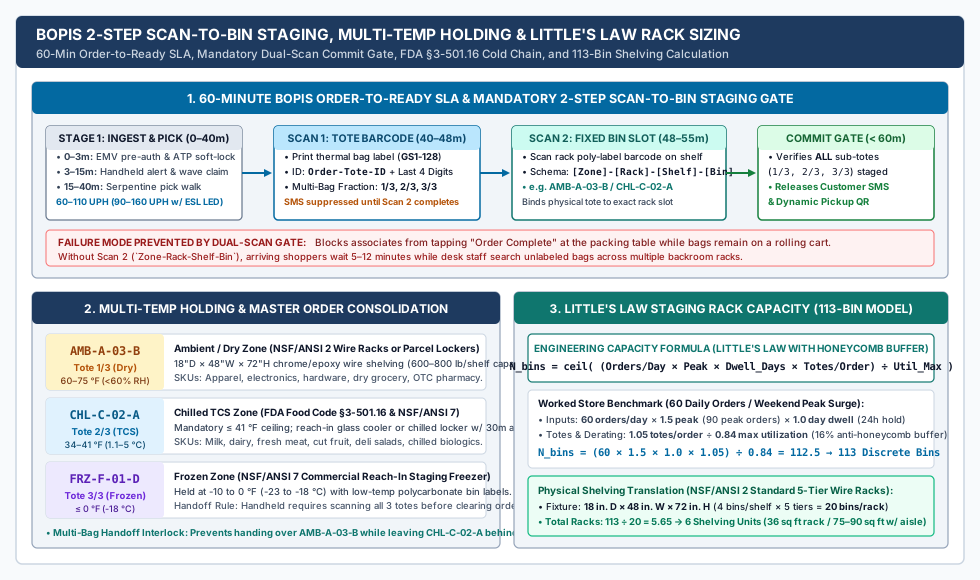
To hit a < 60-minute ready promise without pulling cashiers off the front register during peak trading hours, divide the fulfillment clock into four measurable operational windows:
- Payment Pre-Authorization & Available-to-Promise (
ATP) Soft-Lock (0 to 3 Minutes): When the customer submits a BOPIS order online, the payment gateway places an EMV/card-not-present pre-authorization hold (or immediate capture) and the OMS immediately decrements the store’sAvailable-to-Promise (ATP)inventory counter. To prevent selling the last floor unit to both an online shopper and a walk-in browser simultaneously, configure an online safety-stock buffer (buffer = 1 to 2 units) on fast-moving SKUs so an item displays as"Available for In-Store Pickup"only when on-hand POS inventory is≥ 2 or 3 units. - Pick-Queue Alert & Associate Wave Claim (
3 to 15 Minutes): The order drops into the store’s mobile fulfillment queue and triggers an audible chime on the designated floor associate’s handheld scanner. The associate claims the order (or scheduled batch wave) within10 to 12 minutesof ingestion. - Guided Serpentine Sales-Floor & Backroom Pick Walk (
15 to 40 Minutes): The handheld sorts all line items into a single one-way serpentine walk path sequenced by aisle, bay, and shelf elevation (Zone → Aisle → Bay → Shelf).- Discrete Single-Order Picking (
< 20 to 30 Orders/Day): One associate walks the floor for a single order at a time. While discrete picking eliminates secondary sorting errors and suits urgent15-minuteexpress orders, floor travel distance limits productivity to45 to 75 Units/Picks per Hour (UPH). - Batch / Cluster Cart Wave Picking (
30 to 150+ Orders/Day): On scheduled30- or 60-minutewaves, the associate pushes a6- to 9-totecluster cart through the store, picking items for up to9customers simultaneously in one serpentine pass and scanning each item directly into its assigned order tote. Cluster picking cuts walking distance by45% to 60%and raises pick speed to95 to 150+ UPH—or up to160 UPHwhen shelf bays are equipped with pick-to-light LEDs (5 to 10 mApulse draw with a15 to 30 secondtimeout) as detailed in our guide to electronic shelf labels (ESL): POS sync, 5-year battery life, and rail mounting.
- Discrete Single-Order Picking (
- Packing, Thermal Bag Labeling & Two-Step Scan-to-Bin Staging (
40 to 55 Minutes): Every picked item is verified via a 1DUPC-A / EAN-13barcode scan (preventing size or flavor substitutions without explicit OMS approval), sealed inside a numbered paper or reusable poly bag, and scanned into a fixed physical staging bin before the60-minuteclock expires.
The Mandatory Two-Step Scan-to-Bin Protocol (Preventing the Premature SMS Trap)
The single most damaging operational failure in bopis retail happens at minute 45: an associate finishes bagging an order at the backroom worktable, taps "Order Complete" on the handheld screen before walking the bag to the staging rack, and leaves the bag sitting on a rolling cart while answering a customer question. Because tapping "Complete" fires the automated "Your Order is Ready for Pickup!" SMS and email immediately, a shopper who is already in the neighborhood walks into the store 8 minutes later—only for front-desk staff to spend 5 to 12 minutes rummaging through unlabeled bags across the backroom and front counter.
Eliminate this failure mode by configuring your OMS and handheld workflow to enforce a Mandatory Two-Step Scan-to-Bin Commit Gate using GS1 General Specifications (GS1-128 or Code 128) barcode symbology:
- Scan 1 — Container / Tote Barcode (
Order-Tote-ID): At the packing station, the mobile printer outputs an adhesive thermal bag label displaying the customer’s Last Name + First Initial, the Last 4 Digits of the Order Number in bold36 to 48 pttype for fast visual verification, a machine-readableOrder-Tote-IDbarcode, and the Multi-Container Fraction (Bag 1 of 3 — Ambient,Bag 2 of 3 — Chilled,Bag 3 of 3 — Frozen). The associate scans the tote label. At this point, the order status transitions only toPicked / Packed — Pending Staging(customer SMS remains suppressed). - Scan 2 — Fixed Physical Staging Location Barcode (
Zone-Rack-Shelf-Bin): The associate carries the sealed bag to the staging rack (or automated lobby locker bank) and scans a permanent polypropylene barcode label affixed directly to the physical shelf beam or bin divider. Use a standardized four-part location schema:[TempZone]-[RackID]-[ShelfLevel]-[BinSlot]AMB-A-03-B= Ambient Zone, Rack A, Shelf 3 (from bottom), Bin Slot BCHL-C-02-A= Chilled Cooler C, Shelf 2, Bin Slot AFRZ-F-01-D= Freezer Unit F, Shelf 1, Bin Slot D
- System Commit Gate: The OMS suppresses the customer’s
"Ready for Pickup"notification and dynamic pickup QR code until every sub-tote (1/3,2/3, and3/3) linked to the master order has a verifiedZone-Rack-Shelf-Binscan timestamp.
2. Multi-Temperature Staging Zones (FDA §3-501.16) & Little’s Law Rack Capacity Sizing
When a store sells across dry goods, refrigerated perishables, and frozen items, staging cannot rely on a single dry closet behind the customer service desk. Mixing chilled milk or deli containers into an ambient tote violates food-safety law within minutes, while splitting an order across rooms without an electronic consolidation check causes staff to hand over the dry bag and forget the refrigerated items in the cooler.
Three-Temperature Holding Architecture & FDA Food Code §3-501.16 Compliance
Under FDA Food Code 2022 §3-501.16 (Time/Temperature Control for Safety [TCS] Food, Hot and Cold Holding) and NSF/ANSI 2 and NSF/ANSI 7 Commercial Food Equipment Standards, multi-temperature BOPIS staging areas must segregate bags into three physically distinct, barcode-mapped thermal zones:
| Staging Zone Code & Prefix | Mandatory Operating Temperature & Humidity | Shelving / Cabinet Fixture Specification (NSF/ANSI) |
Typical Merchandising SKU Scope & Handoff Rule |
|---|---|---|---|
1. Ambient / Dry Zone (AMB-) |
60 °F to 75 °F (15.5 °C to 24 °C), < 60% relative humidity (away from direct storefront solar glazing). |
18 in. D × 48 in. W × 72 in. H NSF/ANSI 2 commercial chrome wire or epoxy-coated polymer shelving (600 to 800 lb uniform load per shelf on stationary leveling feet) or steel parcel lockers. |
Apparel, footwear, consumer electronics, hardware, canned/boxed dry grocery, and non-refrigerated pharmacy OTC. |
2. Chilled TCS Zone (CHL-) |
34 °F to 41 °F (1.1 °C to 5.0 °C) strict ceiling per FDA Food Code §3-501.16. |
NSF/ANSI 7 commercial glass-door reach-in staging cooler or refrigerated locker bank with continuous 5-minute digital telemetry logging and a 30-minute door-open recovery alarm. |
Fluid milk, dairy, fresh meat/poultry, cut fruit, prepared deli salads, chilled beverages, and cold-chain biologics. |
3. Frozen Zone (FRZ-) |
≤ 0 °F (-18 °C) — typically held between -10 °F and 0 °F (-23 °C to -18 °C). |
NSF/ANSI 7 reach-in commercial staging freezer fitted with epoxy-coated wire baskets and low-temperature polycarbonate barcode bin labels (rated to -40 °F). |
Ice cream, frozen entrees, frozen meat and seafood, bakery dough, and bagged ice. |
Multi-Bag Master Order Consolidation Interlock: Whenever a single customer basket spans multiple thermal zones, the OMS splits the pick path into zone-specific totes (Tote 1/3 AMB, Tote 2/3 CHL, Tote 3/3 FRZ) bound to one Master Order ID. When the customer arrives at the pickup counter and scans their check-in QR code, the associate’s handheld screen displays all three bin coordinates (AMB-A-03-B, CHL-C-02-A, and FRZ-F-01-D) in red/amber status and blocks the associate from tapping "Complete Handoff" until all three physical tote barcodes are scanned at the counter. If your store uses unattended refrigerated cabinets that authorize payment at the door rather than holding prepaid BOPIS bags, compare the 30-minute FDA §4-204.111 automatic shutoff health lock in our guide to smart vending machines: retail footprint, power, ADA, and network site prep.
Little’s Law Staging Rack Capacity Sizing (Worked 113-Bin Store Calculation)
Undersizing the staging rack is the second major cause of pickup congestion: when bins fill past 85% occupancy during a Friday afternoon rush, associates begin double-stacking unrelated customer orders into the same cubby ("honeycombing"), crushing fragile boxes and hiding barcode labels.
Size your physical staging bin count (N_bins) using an adapted Little’s Law queueing and inventory holding formula that accounts for weekly peak surges, multi-day customer pickup latency (dwell time), multi-tote splitting, and an anti-honeycombing utilization buffer:
N_bins = ceil( (Daily_Orders × Peak_Day_Factor × Avg_Dwell_Days × Avg_Totes_Per_Order) ÷ Max_Bin_Utilization )
Where the five store engineering variables are defined from your POS/OMS logs:
Daily_Orders: Mean daily BOPIS orders fulfilled across the week (e.g., 60 orders/day).Peak_Day_Factor: Ratio of Friday/Saturday or promotional day volume to the weekly mean (typically 1.4 to 1.75 for year-round operations; use 1.5× for standard weekly peak design or 2.0× for Q4 holiday capacity).Avg_Dwell_Days: Mean time a staged order occupies a bin between Scan 2 (Staged) and customer pickup or Return-to-Stock expiration (typically 0.75 to 1.25 days for general retail offering a 3-to-5-day pickup window; 0.25 to 0.50 days for same-day grocery).Avg_Totes_Per_Order: Mean number of discrete bin slots consumed per order (1.0 to 1.15 for specialty/apparel/hardware; 1.6 to 2.2 for multi-temperature grocery).Max_Bin_Utilization: Target peak rack occupancy ceiling (0.80 to 0.85), reserving15% to 20%open buffer slots so associates can always find an empty single-order bin without double-stacking.
Worked Calculation for a 60-Order/Day Specialty or Neighborhood Store
Consider a midsize retail shop processing an average of 60 BOPIS orders/day:
- Peak Daily Staged Order Arrival (
Daily_Orders × Peak_Day_Factor):60 orders/day × 1.5 peak multiplier = 90 peak orders/day. - Active Concurrent Orders in Staging (
× Avg_Dwell_Days): With a1.0-day(24-hour) average customer pickup dwell time:90 peak orders/day × 1.0 day = 90 concurrent active orders. - Total Bin Slots Required with Multi-Tote & Utilization Derating:
At
1.05 totes/orderand a0.84(84%) maximum bin utilization ceiling:N_bins = ceil( (90 × 1.05) ÷ 0.84 ) = ceil( 94.5 ÷ 0.84 ) = ceil( 112.5 ) = 113 discrete staging bins(Note: An equivalent rapid field check without separate tote/utilization factors multiplies60 orders/day × 1.5 peak × 1.25 effective dwell/buffer days = 112.5 → 113 bins.) - Translating
113 Binsinto PhysicalNSF/ANSI 2Wire Shelving Units:- Specify standard heavy-duty
18 in. D × 48 in. W × 72 in. H(457 × 1,219 × 1,829 mm)NSF/ANSI 25-tier commercial wire shelving racks. - Divide each
48 in.wide shelf into4 discrete bin slotsusing snap-on wire shelf dividers and corrugated plastic tote bins (each slot measuring 12 in. W × 18 in. D × 13 in. clear vertical height). - Each 5-tier rack provides
5 shelves × 4 bins/shelf = 20 discrete barcoded bins per rack. - Total Racks Required:
113 bins ÷ 20 bins/rack = 5.65 → 6 shelving units(providing 120 physical barcoded bins: AMB-A-01-A through AMB-F-05-D). - Floor Space Allocation: Six
18 × 48 in.(6.0 sq ft) racks occupy36 sq ft(3.34 m²) of direct rack footprint, or75 to 90 sq ft(7.0 to 8.4 m²) of total floor area when paired with a mandatory36 to 42 in.(915 to 1,065 mm) unobstructed working aisle for cluster picking carts.
- Specify standard heavy-duty
3. Store Circulation, POS Queue Decoupling, and 2010 ADA Wayfinding Signage (§703.5 & §307.4)
The primary promise of bopis retail is frictionless speed. If a customer who already paid online walks into your storefront and is forced to stand in the regular point-of-sale (POS) register queue behind walk-in shoppers with full baskets, price checks, cash counting, and return disputes, their wait time stretches to 4 to 8 minutes. Retail customer satisfaction (CSAT) and repeat pickup adoption drop sharply whenever in-store pickup wait time exceeds 120 seconds (2 minutes).
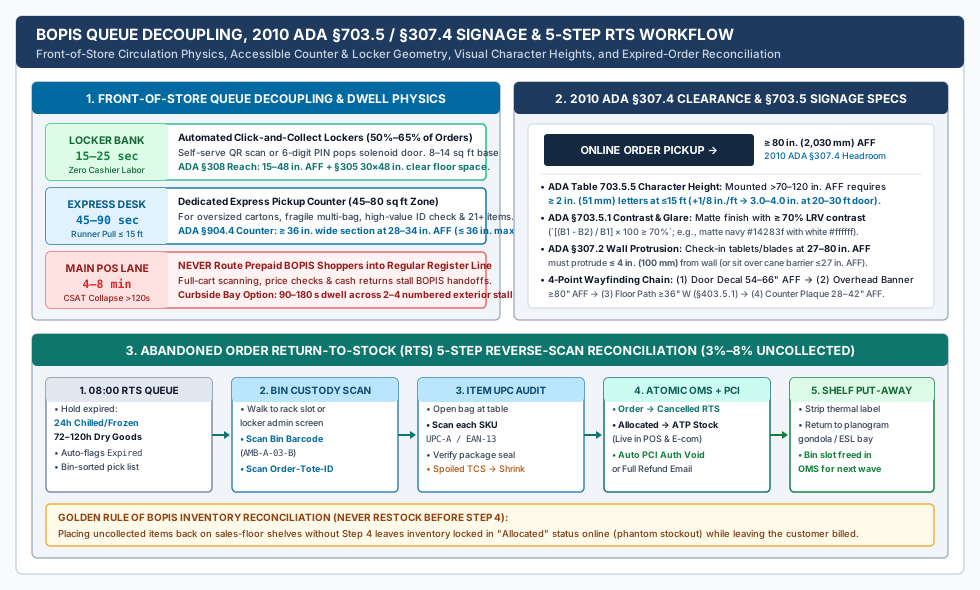
Decoupling Handoff Modalities: Lockers (15–25 s) vs. Express Desk (45–90 s)
To keep average pickup dwell time under 90 seconds without adding dedicated front-desk payroll during slow hours, decouple BOPIS traffic from the primary cash wrap at the front vestibule threshold:
- Automated Front-of-Store Click-and-Collect Lockers (
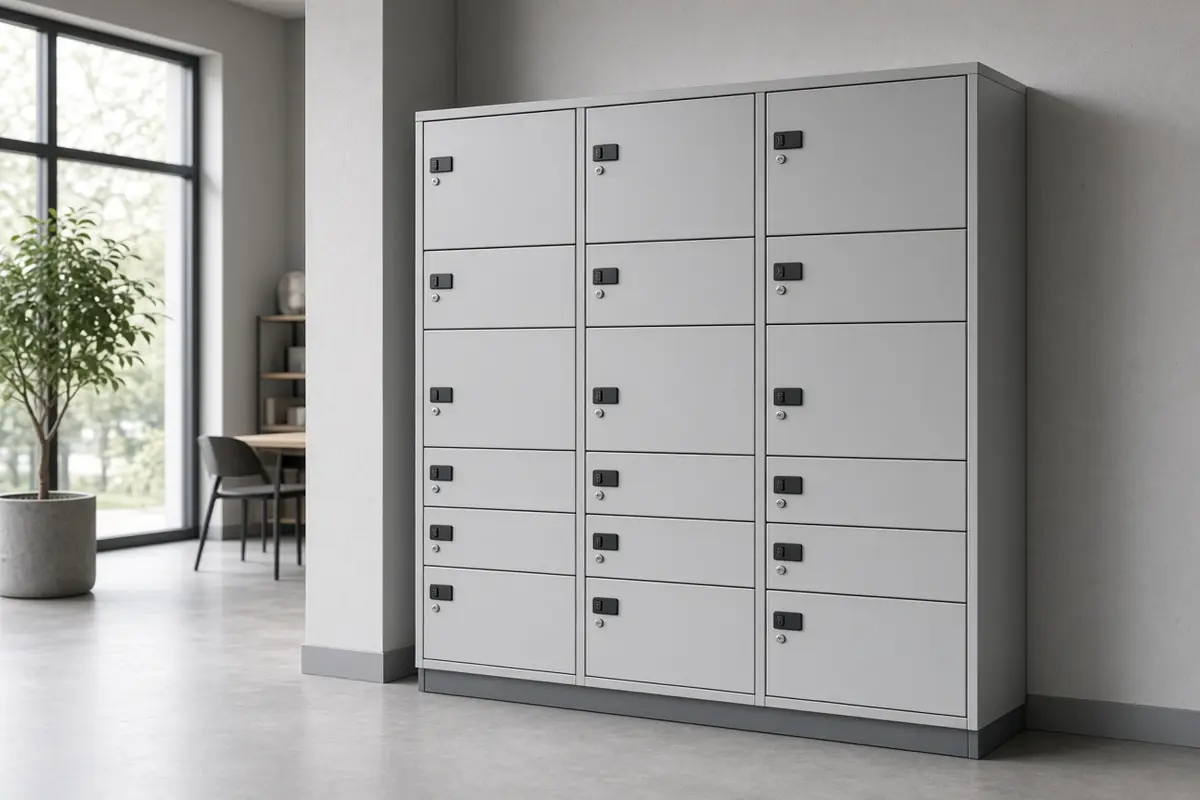
15 to 25 SecondsDwell): Positioning a modular bank of click and collect lockers near the entrance vestibule (inside the climate-controlled lobby with direct sightline from the door) allows customers to scan their confirmation QR code or enter a 6-digit PIN, pop the solenoid compartment latch, and leave in15 to 25 secondswith zero staff intervention. A standard 2- to 3-column locker bank occupies8 to 14 sq ftof base floor area (24 to 36 sq ftincluding the30 × 48 in.wheelchair clear floor space under2010 ADA §305and a36 in.passing aisle) and absorbs50% to 65%of standard small-to-medium ambient orders. Always plan a staffed fallback workflow for locker jam or PIN failures using our checklist before a shop adds self-service. - Dedicated Express Pickup Counter / Service Bypass Lane (
45 to 90 SecondsDwell): Route oversized cartons (> 16 × 18 × 20 in.), fragile multi-bag orders, chilled/frozen items stored in behind-counter glass reach-ins, high-value electronics requiring government photo ID verification, and age-restricted (21+alcohol, tobacco, or lottery) orders to a clearly marked Express Online Pickup counter bay. Place the high-densityAMB/CHL/FRZstaging racks within10 to 15 ft(3.0 to 4.5 m) directly behind or adjacent to this counter so the associate can complete the retrieval and handoff scan in45 to 90 seconds.
Four-Point Visual Wayfinding Chain & 2010 ADA Signage Engineering (§307 & §703.5)
Arriving BOPIS shoppers look for directional cues within the first 3 to 5 seconds of crossing the storefront threshold. If they cannot immediately spot the pickup zone, they interrupt the nearest cashier and stall the checkout line. Design a continuous Four-Point Visual Wayfinding Chain engineered in strict compliance with the 2010 ADA Standards for Accessible Design (Sections 305, 307, 308, 403.5.1, 703.5, and 904.4):
- Point 1 — Exterior Entry Door / Window Decal (
54 to 66 in. AFFEye Level): Apply a matte, high-contrast decal on the entry glazing or vestibule sidelight reading"Online Order Pickup — Inside to the [Left/Right] / Locker Bank"so shoppers orient before stepping into the first promotional display aisle. - Point 2 — Overhead Zone Banner or Suspended Blade Sign (
≥ 80 in. AFFClear Headroom): Hang a high-contrast overhead sign directly over the pickup counter and locker bank, visible from the front entrance door (15 to 35 ftsightline). - Point 3 — Floor Queue Graphics & Accessible Route (
≥ 36 in.Clear Width): Separate the"Express Online Pickup — Have Your QR Code Ready"queue from the"Register Checkout"line using floor decals or stanchions while maintaining a continuous≥ 36 in.(915 mm) accessible walking route (2010 ADA §403.5.1). Keep entry vestibule and pickup waiting floors free of wet umbrella drips, tracked rainwater, and curling loose floor mats in accordance with the UK Health and Safety Executive (HSE) Slips and Trips guidance, and specify slip-resistant commercial flooring and scuff-resistant counter laminates using our guide on busy-room finishes: washing, wear and the day you replace them. - Point 4 — Countertop or Kiosk Check-In Plaque (
28 to 42 in. AFF): Mount a non-glare instructional plaque at the express counter or locker touchscreen detailing the 3-step check-in sequence (1. Open Ready-for-Pickup SMS/Email → 2. Scan QR Code or Tap Check-In → 3. Verify Bag Count [e.g., Bag 1/2 & 2/2]).
| 2010 ADA Standard Section | Mandatory Dimensional or Optical Requirement | BOPIS Wayfinding, Counter & Locker Engineering Rule |
|---|---|---|
| §307.4 — Vertical Clearance (Overhead Signs) | ≥ 80 in. (2,030 mm) minimum clear headroom above the finish floor (AFF) along all circulation paths. |
Measure from the finish floor to the lowest bottom edge of any suspended "ONLINE ORDER PICKUP" sign, cable drop, or light valance. Never hang a promotional banner below 80 in. AFF unless guarded by a floor-mounted cane barrier at ≤ 27 in. (685 mm) AFF. |
| §307.2 — Protrusion Limits (Wall Blades & Kiosks) | ≤ 4 in. (100 mm) maximum horizontal projection for wall-mounted objects with leading edges between 27 in. (685 mm) and 80 in. (2,030 mm) AFF. |
Wall-mounted check-in tablets, barcode scanners, or perpendicular aisle blade signs mounted between 27 and 80 in. AFF must either project ≤ 4 in. from the wall face or sit directly above a base cabinet/wing panel detectable by a long cane below 27 in. AFF. |
§703.5.5 (Table 703.5.5) — Visual Character Height |
• 40–70 in. AFF: ≥ 5/8 in. (16 mm) uppercase 'I' height at ≤ 6 ft distance (+ 1/8 in./ft over 6 ft).• > 70–120 in. AFF: ≥ 2 in. (51 mm) at ≤ 15 ft distance (+ 1/8 in./ft over 15 ft).• > 120 in. AFF: ≥ 3 in. (76 mm) at ≤ 21 ft distance (+ 1/8 in./ft over 21 ft). |
For an overhead "ONLINE PICKUP" sign mounted at 84 to 108 in. AFF viewed from the storefront door 20 to 30 ft away, specify 3.0 to 4.0 in. (76 to 102 mm) uppercase sans-serif characters (stroke thickness 10% to 30% of letter height per §703.5.6). |
§703.5.1 — Finish and Light Reflectance Contrast (LRV) |
Non-glare (matte) finish with high visual contrast between characters and background (≥ 70% LRV contrast benchmark: [(B1 - B2) ÷ B1] × 100 ≥ 70%). |
Avoid glossy acrylic, mirror-finish vinyl, or brushed aluminum signs that wash out under track lighting. Specify matte charcoal/navy (#14283f, LRV ~5%) with crisp matte white text (#ffffff, LRV ~88%) yielding > 90% contrast. |
| §904.4 & §308 — Accessible Pickup Counter & Lockers | • Counter (§904.4): ≥ 36 in. (915 mm) long section at ≤ 36 in. AFF (28–34 in. AFF recommended) + 30 × 48 in. clear space.• Lockers ( §308): Operable parts 15 to 48 in. AFF. |
Do not build a continuous 42 in. high standing-only pickup bar; integrate a lowered 30 to 34 in. AFF accessible handoff surface kept clear of register clutter, and configure your locker OMS to assign wheelchair-accessible orders to compartments between 15 and 48 in. AFF. |
When installing overhead signage frames, lowered counter millwork, and Cat6/power conduits in an operating storefront, schedule the carpentry and electrical work overnight using our guide on planning a partial refit while the shop stays open.
4. Abandoned Order Return-to-Stock (RTS) & Reverse-Scan Inventory Reconciliation
Across commercial retail, 3% to 8% of staged BOPIS orders are never collected by the customer. Without a scheduled, scan-enforced Return-to-Stock (RTS) reconciliation protocol, uncollected bags create three compounding operational failures:
- Staging Bin Exhaustion: Expired bags clog
15% to 25%of rack slots within two weeks, forcing associates to stack new orders on the floor. - Perishable Cold-Chain Shrink: Uncollected milk, meat, or prepared foods expire inside the staging cooler.
- Phantom Inventory Locks & Customer Billing Disputes: When a well-meaning floor associate pulls an old BOPIS bag off the rack and places the merchandise directly back onto the sales-floor shelf without executing an OMS return-to-stock cancellation scan, the ERP/POS inventory ledger still holds that unit in
Allocated / Reserved BOPISstatus. Online shoppers see the item as"Out of Stock"(phantom stockout), the original online buyer is never refunded (triggering a chargeback), and if a walk-in shopper buys that physical unit at the register, the store’s on-hand inventory count goes negative (-1).
Hold Windows & Automated Customer Reminder Cadence
Establish explicit hold windows in your checkout terms and configure the OMS to send automated SMS/email reminders before flagging an order as expired:
- Chilled, Frozen & Fresh Perishable Grocery (
24-Hour Hold Window):- Notification Cadence:
T+0 h(Ready for PickupSMS + QR code) →T+4 h(Mid-day pickup reminder) →T+18 h(Final Notice: Order expires in 6 hours) →T+24 h(Expired — Moved to Morning RTS Queue). - Food-Safety Disposition Rule: Sealed, continuously refrigerated (
≤ 41 °F) dairy or frozen items with verified cooler telemetry logs may be returned to stock; custom-sliced deli meats, open bakery items, or any TCS food whose cold chain cannot be verified must be logged as waste/shrink.
- Notification Cadence:
- General Merchandise, Apparel, Hardware & Dry Goods (
72- to 120-Hour / 3- to 5-Day Hold Window):- Notification Cadence:
T+0 h(Ready for Pickupalert) →T+24 h(Reminder 1) →T+48 h(Reminder 2with optional 1-click"Extend My Hold by 48 Hours"link) →T-6 h before expiration(Final Pickup Warning) →T+72 h to T+120 h(Expired — Moved to Morning RTS Queue). Urban small-footprint shops with tight shelving typically enforce72 hours(3 days), whereas suburban or big-box formats allow120 to 168 hours(5 to 7 days).
- Notification Cadence:
The 5-Step Reverse-Scan RTS Reconciliation Workflow
Run the Return-to-Stock sweep every morning at 08:00 local store time (before the doors open and before the first morning pick wave begins) using a mandatory five-step reverse-scan sequence:
- Step 1 — Automated
08:00Morning RTS Exception Queue: At08:00, the OMS automatically transitions all orders past their24-hour(perishable) or72–120 hour(dry) hold cutoff fromStagedtoExpired — Pending RTS. This immediately disables the customer’s pickup QR code/PIN (so a late-arriving customer cannot open a locker door while the associate is pulling the bag) and pushes a bin-sorted retrieval list to the opening associate’s handheld scanner. - Step 2 — Physical Staging Bin & Tote Custody Scan: The associate walks to the exact rack slot (
e.g., AMB-A-03-B) or opens the locker bank’s"Retrieve Expired Parcels"administrator menu, scans the fixed location barcode (or locker door confirmation), and scans theOrder-Tote-IDthermal bag label. This clears the bin slot (AMB-A-03-B) in the OMS so it is immediately available for the morning’s new pick wave. - Step 3 — Line-Item
UPC-A / EAN-13Verification & Condition Audit: At the backroom packing table, the associate opens the bag and scans the retailUPC-AorEAN-13barcode on every individual item inside the tote. Item-level scanning verifies that no item was missing from the bag and prompts the associate to confirm whether each SKU is in"Sellable — Return to Shelf"condition or"Damaged / Perishable Waste — Log to Shrink". - Step 4 — Atomic OMS Order Cancellation,
ATPInventory Release & PCI Payment Reversal: Only when the final item UPC in the order is scanned does the OMS execute an atomic three-way transaction:- Marks the order line status as
Cancelled — Uncollected RTS. - Releases the sellable item quantity from
Allocated / Reserved BOPISback into liveAvailable-to-Promise (ATP) On-Handinventory in both the POS and e-commerce storefront. - Transmits an automated, PCI-DSS-compliant payment gateway
Authorization Reversal / Void(if funds were held under a card pre-authorization) orFull Credit Refund(if funds were captured at checkout), and emails an itemized cancellation and refund confirmation receipt to the customer.
- Marks the order line status as
- Step 5 — Physical Put-Away to Sales-Floor Gondola Planogram: The associate peels off or obliterates the thermal BOPIS bag label (
so customer PII is never left on a shelf) and returns each item to its home gondola shelf bay.- Golden Rule of BOPIS Inventory Integrity: Never place an uncollected BOPIS item back onto a sales-floor shelf until Step 4 displays
"Inventory Released & Refund Issued"on the handheld terminal.
- Golden Rule of BOPIS Inventory Integrity: Never place an uncollected BOPIS item back onto a sales-floor shelf until Step 4 displays
5. BOPIS Labor, Shelving CapEx, and Operating Cost Worksheet Connection
Before expanding your pickup promise or purchasing automated locker banks, connect the capital and labor requirements of your in store pickup workflow to the store’s actual payroll, lease occupancy, utility bills, and shrink ledgers using our small-store operating cost worksheet:
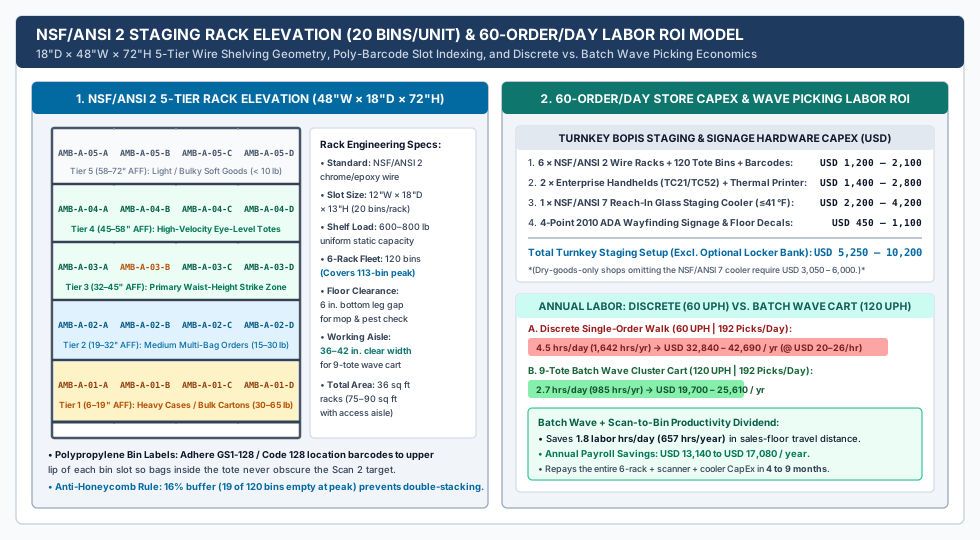
| Cost Worksheet Line Category | BOPIS Retail Engineering Driver (60 Orders/Day Store Benchmark) |
Typical Capital or Operating Cost Range (USD) |
Source Document to Copy From |
|---|---|---|---|
1. Staging Rack & Hardware CapEx (Upfront Equipment) |
6 × NSF/ANSI 2 wire racks (18 × 48 × 72 in., 120 bins) + polypropylene bin barcodes + 2 enterprise handheld scanners (Zebra TC21/TC52) + 1 thermal label printer + 1 commercial NSF/ANSI 7 reach-in cooler (if selling chilled TCS items). |
• 6 Wire Racks + 120 Tote Bins: USD 1,200 – USD 2,100• 2 Handhelds + Thermal Printer: USD 1,400 – USD 2,800• 1 Reach-In Staging Cooler: USD 2,200 – USD 4,200• 2010 ADA Signage Package: USD 450 – USD 1,100 |
Vendor equipment quotes, commercial refrigeration cut sheets, and sign-shop proofs. |
2. Store Picking, Staging & RTS Labor (Payroll Line) |
At 60 orders/day (average 3.2 items/order = 192 picks/day):• Discrete Picking ( 60 UPH): 3.2 hrs/day pick + 1.0 hr staging/handoff + 0.3 hr morning RTS = 4.5 labor hrs/day (1,642 hrs/yr).• Batch Wave Cart ( 120 UPH): 1.6 hrs/day pick + 0.8 hr staging/handoff + 0.3 hr RTS = 2.7 labor hrs/day (985 hrs/yr). |
At USD 20 to USD 26/hr loaded retail wage:• Discrete: USD 32,840 – USD 42,690 / yr• Batch Wave: USD 19,700 – USD 25,610 / yr(Batch wave picking saves USD 13,140 – USD 17,080/yr in floor walking labor.) |
Monthly store payroll register and OMS handheld pick-rate (UPH) reports. |
3. Floor Occupancy Allocation (Lease Line) |
75 to 90 sq ft backroom/behind-counter staging rack zone + 45 to 80 sq ft front-of-house express counter or 24 to 36 sq ft locker alcove = 100 to 170 sq ft total allocated footprint. |
Multiply allocated sq ft by the store’s actual base rent + CAM per sq ft (copied directly from your signed commercial lease). |
Current dated commercial lease and floor plan tape measurement. |
4. Cold-Chain Energy & Consumables (Utility & Upkeep Line) |
NSF/ANSI 7 glass-door staging cooler (3.0 to 5.5 kWh/day = 1,095 to 2,007 kWh/yr) + GS1-128 direct-thermal bag labels & poly bags (21,900 orders/yr × 1.15 labels = ~25,200 labels/yr). |
• Cooler Electricity: USD 200 – USD 560 / yr (at USD 0.18–0.28/kWh)• Thermal Labels & Bags: USD 650 – USD 1,400 / yr |
Monthly electric utility meter bill and packaging supplier invoices. |
6. Pre-Launch Site Survey & Operations Audit Checklist
Before publishing an "Order Online, Pick Up in 1 Hour" banner on your website or signing an OMS/hardware service contract, walk the sales floor and backroom with a tape measure and barcode scanner. Lock hardware fault response times, scanner spares, and POS/OMS integration duties into your equipment agreement using our vendor service checklist for shop equipment:
- Two-Step Scan-to-Bin Gate Enforced: Confirm in the OMS that tapping "Picked" at the packing table does not trigger the customer's Ready for Pickup SMS or QR code until both the container label (Order-Tote-ID) and the fixed shelf slot barcode (Zone-Rack-Shelf-Bin, e.g., AMB-A-03-B) are scanned.
- Multi-Temperature Cold Chain & Consolidation Verified: For stores staging perishable food, verify separate barcoded Ambient (60–75 °F), Chilled TCS (34–41 °F per FDA Food Code §3-501.16), and Frozen (≤ 0 °F) zones, and test that the handheld blocks order handoff until all sub-totes (1/3, 2/3, 3/3) are scanned together.
- Staging Rack Capacity Sized via Little's Law: Calculate peak bin demand from your daily order target, 1.5x peak-day surge, customer dwell days, and an 80%–85% maximum utilization cap (e.g., 113 bins across six 18 × 48 × 72 in. NSF/ANSI 2 five-tier racks for 60 orders/day) with a 36 to 42 in. working aisle.
- POS Checkout Queue Decoupled: Separate prepaid BOPIS customers from the 4 to 8 minute main cash-wrap queue using either automated click and collect lockers (15–25 s dwell, operable parts at 15–48 in. AFF per 2010 ADA §308) or a dedicated Express Pickup counter section (45–90 s dwell, ≥ 36 in. wide surface at 28–34 in. AFF per ADA §904.4).
- 2010 ADA Wayfinding Signage & Headroom Checked: Measure ≥ 80 in. (2,030 mm) vertical clearance beneath all overhead signs (§307.4), ≤ 4 in. (100 mm) wall projection for check-in tablets between 27 and 80 in. AFF (§307.2), and 3.0 to 4.0 in. matte high-contrast letters (≥ 70% LRV contrast) for overhead signs viewed from 20 to 30 ft (Table 703.5.5).
- 08:00 Morning Return-to-Stock (RTS) Protocol Active: Schedule a daily 08:00 reverse-scan sweep for expired orders (24 h chilled / 72–120 h dry) that scans the bin, tote, and item UPCs to trigger atomic OMS cancellation, Available-to-Promise (ATP) inventory release, and PCI-DSS refund/void before any item returns to a sales-floor shelf.