Deploying commercial smart vending machines requires verifying the full 24 to 32 sq ft operational floor envelope, four-point leveling-leg structural loads, dedicated 115–120V GFCI branch circuits, and dual-path network telemetry before the delivery truck arrives. Treating an automated cabinet like a standard plug-in appliance causes compressor thermal-overload downtime, FDA Food Code health-lock inventory waste, cracked floor tile from concentrated point loads, and failed EMV card authorizations in shielded building cores.
Store owners and facility managers evaluating an automated retail deployment inside a shop, lobby, or unattended micro-market corridor must match the cabinet’s dispensing architecture to the packaging format while completing unattended retail site prep from the manufacturer cut sheet and an on-site utility survey. Pair the physical utility and clearance specifications below with our operational checklist before a shop adds self-service inside the retail technology hub so payment exceptions, restocking schedules, and service logs are settled alongside the building work.
| Hardware Modality & Representative Platforms | Checkout & Inventory Sensing Mechanism | Compatible SKU & Packaging Profile | Typical Footprint & Dry / Stocked Weight | Electrical Load (115–120V AC, 60 Hz) | WAN Telemetry Bandwidth & Uptime Need |
|---|---|---|---|---|---|
1. AI Computer-Vision + Load-Cell Smart Coolers (365 PicoCooler Vision, Micromart GEN4/GEN5, Cantaloupe Smart Store 600) |
EMV tap or badge scan places a temporary pre-auth hold (USD 10–25) and releases the electromagnetic door lock. Overhead wide-angle cameras + strain-gauge shelves (±1 to 2 g resolution) settle the basket 3–8 s after door closure. | Irregular, non-rigid, high-margin fresh items: salad bowls, tapered yogurt cups, grab-and-go sandwiches, cardboard meal boxes, glass bottles. Zero coil/drop jams. | 29.5–32.0 in. W × 23.5–37.75 in. D × 72.0–79.6 in. H; dry 300–350 lb, stocked 650–800 lb. |
3.4–4.6 A steady running draw (400–520 W); 18–25 A compressor LRA startup inrush. |
High (5–15 Mbps sustained upload) via RJ45 Cat6 for short transaction video clips and OTA neural-network updates. |
2. Robotic X-Y-Z Elevator / Soft-Drop Merchandisers (Crane BevMax MEDIA2 40"/47", Fastcorp / Wittern Robotic Kiosks) |
Customer selects on a 7–21.5 in. capacitive touchscreen and completes EMV payment (plus optional 2D PDF417 ID age scan). Motorized X-Y-Z plunger/elevator lowers item to a locked delivery port; infrared optical vend beam verifies delivery before card capture. |
Fragile glass beverage bottles, carbonated cans, consumer electronics, cosmetics, OTC pharmacy kits that would shatter, dent, or foam in a 3–5 ft gravity drop. | 40.0–47.0 in. W × 33.5 in. D × 72.0 in. H; dry 637–688 lb, stocked 950–1,100 lb. |
7.5–8.5 A steady running draw (860–980 W) for refrigerated; 22–28 A compressor LRA startup inrush. |
Low to Moderate (1–5 Mbps) for real-time EMV authorization, MDB 4.3 / DEX polling, and digital signage playlists. |
3. Modular UHF RFID Smart Cabinets (ISO/IEC 18000-63 / EPCglobal Gen2v2, 902–928 MHz ISM band) |
Faraday-shielded enclosure (metallized glass and conductive door gasket) unlocks on card tap. Multi-antenna UHF readers scan all EPC tags before opening and re-poll for 2–5 s after latch closure, billing missing serials. |
Mixed box sizes, stacked apparel, electronics, meal containers, or medical kits carrying a serialized UHF inlay (> 99.5% dry accuracy; liquids/foil require 5–10 mm dielectric foam spacers). |
30.0–36.0 in. W × 30.0–35.0 in. D × 72.0–78.0 in. H; dry 280–360 lb, stocked 500–750 lb. |
1.5–3.0 A (175–350 W) ambient; 3.5–4.8 A refrigerated. Adds USD 0.06–0.15 per unit in UHF tag hardware. |
Low (1–3 Mbps) for serialized EPC inventory delta logs and EMV payment settlement. |
1. Smart Vending Hardware Architectures: Matching Dispensing Mechanics to SKU Packaging
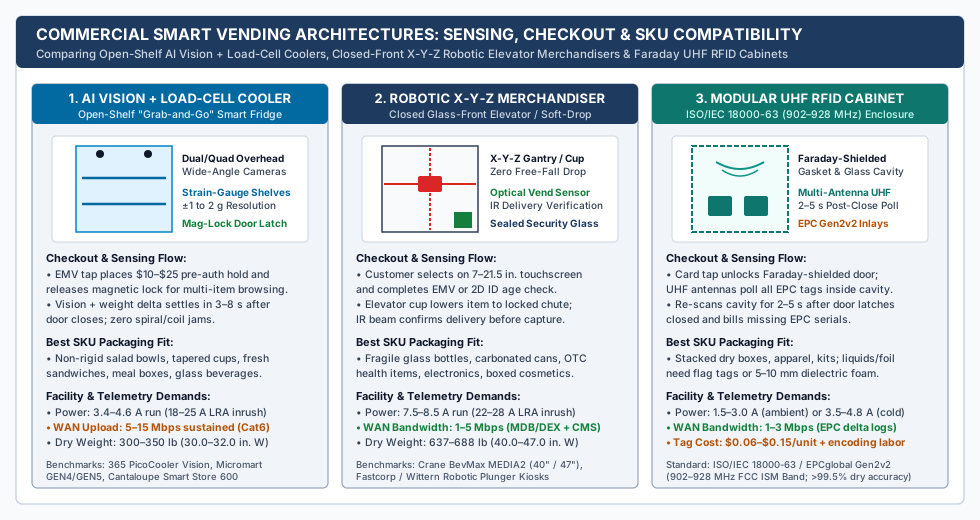
Modern commercial smart vending machines replace single-price mechanical coin mechanisms and fixed helical coils with connected telemetry, EMV contactless pre-authorization, and automated item tracking. Selecting the wrong cabinet architecture for your product packaging introduces one of three dominant operational failure modes: mechanical bridging in gravity chutes, optical/RF blind spots on liquid or foil containers, or excessive shrink when high-theft merchandise is placed in an open-shelf cooler.
AI Computer-Vision and Load-Cell Smart Coolers (Open-Shelf Grab-and-Go)
Open-shelf smart coolers—represented by commercial platforms such as the 365 Retail Markets PicoCooler Vision, Micromart Smart Store (GEN4/GEN5), and Cantaloupe Smart Store 600 / Cooler Café—eliminate internal dispensing motors altogether. When a shopper taps an EMV contactless card, mobile wallet, or campus badge, the payment terminal requests a temporary pre-authorization hold (typically USD 10 to USD 25) and releases an electromagnetic door latch.
Once the door opens, shoppers can pick up multiple items, read nutrition labels, and return unwanted products to any shelf. Overhead dual or quad wide-angle cameras track hand and package trajectories while strain-gauge load cells integrated beneath each shelf measure weight changes at ±1 to 2 g resolution. Sensor fusion between visual object recognition and shelf weight deltas prevents misclassification when two items have similar wrapper graphics but different net weights, or when a customer moves a bottle from Shelf B to Shelf C. Within 3 to 8 seconds after the door swings shut and re-latches, the edge controller finalizes the itemized receipt and captures the exact transaction total.
- Operational Advantage: Because products sit on flat wire or sensor shelves, the store can stock high-margin, non-rigid packaging—flanged plastic salad bowls, tapered yogurt cups, triangular sandwich wedges, and hexagonal meal boxes—with a zero mechanical jam rate.
- Site-Prep Trade-Off: Open-shelf AI cabinets demand
5 to 15 Mbpsof sustained upload throughput to push short validation video clips to the cloud and download updated neural-network weights whenever seasonal packaging graphics change.
Robotic X-Y-Z Elevator and Soft-Drop Smart Merchandisers
Where store security requires keeping the inventory behind locked glazing until payment completes, robotic glass-front merchandisers—such as the Crane BevMax MEDIA2 (40.0 in. narrow or 47.0 in. wide) and Fastcorp / Wittern vacuum-gripper or belt-pusher kiosks—isolate every SKU behind dual-pane tempered glass or impact-resistant polycarbonate. The customer builds a multi-item cart on a 7 to 21.5 in. capacitive touchscreen and completes EMV payment (alongside a 2D PDF417 driver’s license scan or biometric check where age-restricted goods are sold).
Instead of rotating a wire spiral and dropping a bottle 4 feet into a bottom bin, a motorized X-Y-Z gantry cup or horizontal elevator shelf travels to the exact tray row and column (X-Y coordinates), extracts the item via a plunger, conveyor belt, or vacuum cup (Z axis), and lowers it smoothly to a locked delivery port at waist height. Dual infrared optical vend-sensor beams across the delivery chute verify that the physical package arrived in the bin before capturing the credit card authorization. If an item fails to clear the tray, the controller automatically attempts an alternate column containing the same SKU or voids the charge immediately, preventing unfulfilled-vend disputes.
Modular UHF RFID Smart Cabinets (ISO/IEC 18000-63)
Modular RFID cabinets operate in the 902 to 928 MHz ultra-high-frequency (UHF) ISM band using the ISO/IEC 18000-63 (EPCglobal Gen2v2) air-interface protocol. The cabinet chassis uses metallized shielding glass and conductive perimeter door gaskets to form a localized Faraday cage so the reader does not accidentally poll tagged inventory sitting on nearby shop shelves.
Before unlocking the door on card tap, internal multiplexer antennas inventory every Electronic Product Code (EPC) serial inside the enclosure. After the customer removes items and closes the door, the reader polls the cavity for 2 to 5 seconds and bills the card for any missing EPC serials. While UHF RFID achieves > 99.5% read accuracy on dry boxed goods, apparel, and medical/industrial supply kits, water absorbs UHF RF energy and metal foil reflects it. Stocking bottled beverages or foil-wrapped snacks inside an RFID cabinet requires specialized flag tags or 5 to 10 mm dielectric foam spacers, plus USD 0.06 to USD 0.15 per item in consumable inlay hardware and back-room encoding labor.
Key Takeaway: If your shop is deploying cabinets solely to hold prepaid online orders rather than authorizing point-of-sale payment and tracking live shelf inventory, evaluate a parcel locker workflow instead—see our companion analysis on collection lockers and why the cabinet is not the order system.
2. Unattended Retail Site Prep: Physical Footprint, Structural Point Loads, and Rigging Path
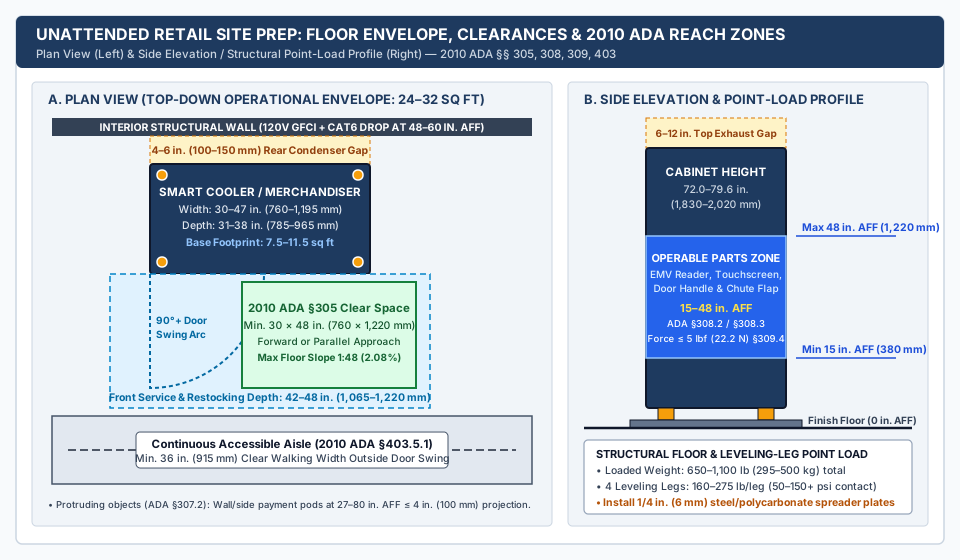
A frequent planning mistake during unattended retail site prep is sizing the floor allocation solely from the cabinet’s exterior chassis width and depth. While a single commercial smart cooler or glass-front merchandiser occupies only 7.5 to 11.5 sq ft (0.70 to 1.07 m²) of base area, its true operational floor envelope requires 24 to 32 sq ft (2.23 to 2.97 m²) once condenser ventilation, full door-swing geometry, route-driver restocking staging, and accessible customer clearance are included.
Verified Manufacturer Dimensional and Weight Benchmarks
Always copy the exact width, depth, height, and dry weight from the manufacturer specification sheet for the model on your purchase order, and record those figures with your site-survey tape measurements:
- 365 Retail Markets PicoCooler Vision:
30.0 in. W × 32.62 in. D × 78.75 in. H(762 × 829 × 2,000 mm); dry weight340 lb(154.4 kg). - Micromart Smart Store Fridge (GEN4/GEN5):
30.0–30.5 in. W × 36.7–37.75 in. D(including door handle and payment housing)× 79.0–79.6 in. H; dry weight340–350 lb(154–159 kg). - Cantaloupe Smart Store 600 / Cooler Café:
29.5–32.0 in. W × 23.5–27.88 in. D × 72.0–78.88 in. H; dry weight~300 lb(136 kg). - Crane BevMax MEDIA2 (Robotic Glass-Front): Narrow chassis
40.0 in. W × 33.5 in. D × 72.0 in. H(dry weight637 lb/289 kg); Wide chassis47.0 in. W × 33.5 in. D × 72.0 in. H(dry weight688 lb/313 kg).
Condenser Airflow and Door-Swing Clearances
- Rear and Top Condenser Ventilation Gap: Maintain an unobstructed
4 to 6 in.(100 to 150 mm) air gap behind the cabinet and6 to 12 in.(150 to 305 mm) above top-exhausting refrigeration decks. Pushing a smart cooler flush against drywall or boxing it inside unventilated architectural millwork traps condenser discharge heat. As ambient air at the condenser intake rises above90 °F (32.2 °C), compressor head pressure climbs, daily electricity consumption increases by25% to 40%, and compressor pull-down recovery slows enough to trip the food-safety health lock. - Front Door-Swing and Restocking Staging Zone: Maintain
42 to 48 in.(1,065 to 1,220 mm) of clear depth directly in front of the cabinet face. A30 to 47 in.wide hinged glass door requires a full90° to 105°swing arc so route drivers can slide out shelf trays and stage restocking totes or a hand truck without blocking emergency egress.
Worked Structural Calculation: Uniform Floor Load vs. Leveling-Leg Point Stress
Facility leases often specify a permissible uniform live load—such as 100 lb/sq ft (4.79 kN/m²) for ground-floor retail slabs or 50 to 75 lb/sq ft for older wood-joist and raised-access office floors. However, vending machines do not distribute weight uniformly across their base footprint; the entire mass rests on four threaded steel leveling legs, each typically 1.5 to 2.0 in. (38 to 51 mm) in diameter.
Consider a conditional site-engineering calculation across two standard machine classes:
- Scenario A (Stocked AI Smart Cooler):
350 lbdry cabinet +310 lbperishable food and beverage load =660 lb(299 kg) total operating weight over an8.2 sq ftbase (80.5 lb/sq ftaverage uniform load). Distributed across four1.75 in.diameter leveling pads (Area = π × 0.875² = 2.405 in²per pad), each leg carries165 lb(75 kg), generating a concentrated contact stress of:P = 165 lb ÷ 2.405 in² = 68.6 psi(473 kPa). - Scenario B (Stocked Wide Robotic Beverage Merchandiser):
688 lbdry cabinet +412 lbbottled/canned beverage cases =1,100 lb(499 kg) total operating weight over a10.9 sq ftbase (100.9 lb/sq ftaverage uniform load). On four1.5 in.diameter leveling pads (1.767 in²per pad), each leg carries275 lb(125 kg), generating a contact stress of:P = 275 lb ÷ 1.767 in² = 155.6 psi(1,073 kPa)—and over300 psimomentarily on two legs when the cabinet is rocked onto a pallet jack during delivery.
To prevent point-load failure modes—such as cracked hollow-bed ceramic tiles, crushed acoustic underlayment, or permanent indentation in resilient vinyl—install 1/4 in. (6 mm) powder-coated steel or high-density polycarbonate load-spreader plates (6 × 6 in. minimum per foot, or full-length steel skid channels) beneath the four leveling legs. Before selecting flooring materials or protective skids for a high-traffic vending alcove, review our material wear guide on busy-room finishes: washing, wear and the day you replace them.
Rigging Path, Doorway Clearances, and Condensate Slip Prevention
When bringing a 300 to 688 lb cabinet into an operating storefront, coordinate the delivery path using our guide on planning a partial refit while the shop stays open:
- Doorway Clear Width: Verify a continuous
36 in.(915 mm) minimum clear opening from the loading dock or curb to the final alcove. A33.5 to 37.75 in.deep cabinet must be turned sideways through a36 in.door frame; if the clear opening is32 to 34 in., the rigging crew must remove the machine’s outer door or payment bezel beforehand. - Compressor Oil-Settling Rule: Never tilt a compressor-equipped cabinet past
30° to 45°on stair climbers or threshold ramps. If horizontal tilting occurs during rigging, leave the cabinet upright and unenergized for12 to 24 hoursbefore plugging it in so displaced polyolester (POE) or mineral lubricating oil drains back into the compressor sump; energizing immediately causes dry-start cylinder scoring. - Floor Slip Prevention: Refrigerated cabinets condense ambient humidity across their evaporator coils and drain pan. In humid storefronts or near exterior doors, verify that the condensate evaporation pan and drain tube sit level, and keep the customer standing zone free of water drips or curl-prone loose mats in accordance with the UK Health and Safety Executive (HSE) Slips and Trips guidance.
3. 2010 ADA Standards & NAMA Accessibility Compliance in Public Corridors
Whenever smart vending machines are placed in public accommodations, commercial facilities, retail aisles, or employee common areas, installation geometry and control hardware must satisfy the 2010 ADA Standards for Accessible Design (U.S. Department of Justice / U.S. Access Board, §§ 305, 307, 308, 309, and 403) alongside NAMA accessibility design rules.
| 2010 ADA Standard Section | Mandatory Dimensional or Mechanical Parameter | Unattended Retail Site-Prep & Hardware Verification Rule |
|---|---|---|
| §308.2 & §308.3 — Unobstructed Forward & Side Reach | 15 in. (380 mm) min to 48 in. (1,220 mm) max above the finish floor (AFF). | Every customer-operable part—EMV card tap reader, bill/coin slot, physical keypad, smart-cooler door handle, and product delivery chute flap—must sit strictly between 15 in. and 48 in. AFF. On tall 21.5 in. touchscreens whose top edge exceeds 48 in. AFF, enable the on-screen ADA Accessible Keypad mode positioned in the lower screen zone (≤ 48 in. AFF). |
| §305.2, §305.3 & §305.5 — Clear Floor or Ground Space | 30 in. × 48 in. (760 × 1,220 mm) min clear rectangle; max floor slope 1:48 (2.08%). | Position the 30 × 48 in. clear space for either a forward or parallel wheelchair approach directly in front of the operable controls. Keep trash bins, recycling totes, and promotional sign stanchions completely outside this rectangle. |
| §309.4 — Operation & Maximum Activation Force | One-handed operation; no tight grasping, pinching, or wrist twisting; ≤ 5 lbf (22.2 N) activation force. | Verify that the smart cooler’s unlatched door pull and the anti-theft delivery bin flap on robotic merchandisers require no more than 5 lbf of push/pull force and use a loop or lever handle rather than a recessed pinch latch. |
| §403.5.1 & §307.2 — Accessible Route & Protruding Objects | ≥ 36 in. (915 mm) continuous clear walking width; max 4 in. (100 mm) wall protrusion between 27 in. and 80 in. AFF. |
The 36 in. minimum accessible corridor width must remain clear outside the cabinet chassis depth. Recess multi-machine banks into alcoves or add cane-detectable wing panels to the floor if side-mounted payment pods protrude more than 4 in. between 27 and 80 in. AFF. |
4. Electrical Branch Circuits, DOE Energy Ceilings, and FDA §4-204.111 Health Lock
Electrical and thermal commissioning errors account for the majority of nuisance service calls during the first 60 days of an automated retail deployment.
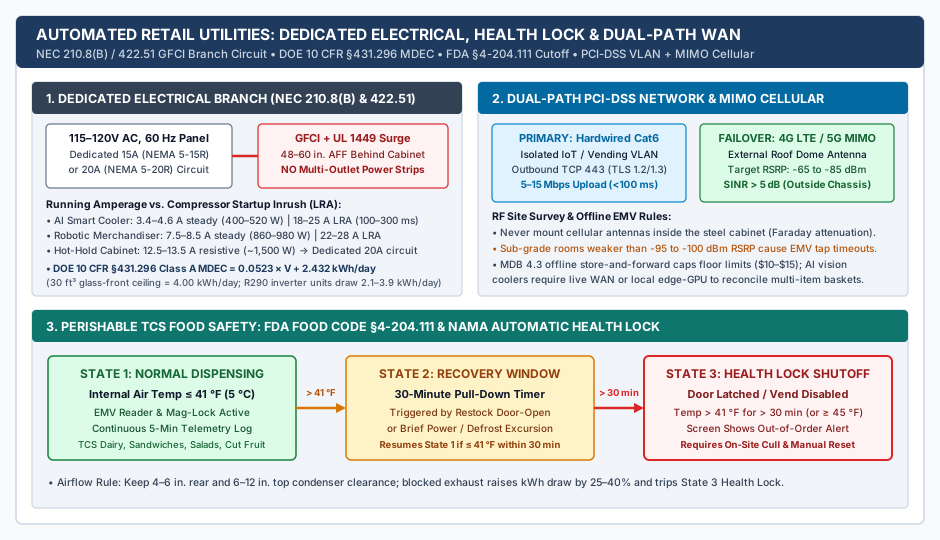
Dedicated Branch Circuits and Compressor Inrush (LRA)
Install a dedicated 115–120V AC, 60 Hz, single-phase 15A (NEMA 5-15R) or 20A (NEMA 5-20R) individual branch circuit wired directly back to the electrical panelboard for each refrigerated smart cooler or robotic beverage machine, with the receptacle mounted at 48 to 60 in. AFF behind the cabinet so the plug remains accessible without moving a 1,000 lb stocked unit:
- AI Smart Coolers (
365 PicoCooler Vision,Micromart GEN4/GEN5): Draw3.4 to 4.6 A(400 to 520 W) during steady-state cooling, but experience compressor Locked Rotor Amps (LRA) startup inrush currents of18 to 25 Afor100 to 300 millisecondswhenever the compressor clutch engages. - Robotic Refrigerated Glass-Front Merchandisers (
Crane BevMax MEDIA2): Draw7.5 to 8.5 A(860 to 980 W) steady state, with compressor LRA inrush reaching22 to 28 A. - Ambient / Dry Smart Merchandisers & UHF RFID Lockers: Draw
1.5 to 3.0 A(175 to 350 Wfor LED cabinet lighting, touchscreen compute, router, and lock/elevator actuators). Two ambient cabinets may share a single20Abranch circuit where manufacturer instructions and local code permit. - Heated / Hot-Hold Smart Cabinets (
Cantaloupe Smart Store Hot Hold): Draw12.5 to 13.5 A(~1,500 Wresistive heating element), requiring a dedicated20Acircuit (80%continuous-load derating limit on a15Acircuit is12.0 A).
Under NFPA 70 (National Electrical Code) Article 210.8(B) and Article 422.51, cord-and-plug-connected vending machines must incorporate Ground-Fault Circuit-Interrupter (GFCI) protection—either integrated into the machine’s factory LCDI/GFCI power cord or provided via a GFCI receptacle/circuit breaker—paired with commercial UL 1449 transient voltage surge suppression to protect the AI vision GPU and Multi-Drop Bus (MDB 4.3) controller. Never connect a refrigerated cabinet through a consumer multi-outlet power strip, cube tap, or ungrounded extension cord: shared neutral/hot contacts overheat under continuous compressor cycling, and simultaneous compressor restarts across two machines on a shared circuit will exceed 35 to 50 A instantaneous LRA and trip the thermal-magnetic breaker.
DOE 10 CFR §431.296 MDEC Formulas & Store Operating Cost Calculation
Under U.S. Department of Energy (DOE) conservation regulations at 10 CFR §431.296 and ENERGY STAR Program Requirements for Refrigerated Beverage Vending Machines (Version 3.1), maximum daily energy consumption (MDEC, in kWh/day) is governed by refrigerated volume (V, in ft³):
- Class A (Fully Cooled Glass-Front Cabinet):
MDEC = 0.0523 × V + 2.432 kWh/day - Class B (Opaque-Front / Zone-Cooled Cabinet):
MDEC = 0.0657 × V + 2.844 kWh/day
Worked Utility & Telemetry Cost Example: For a standard V = 30 ft³ Class A glass-front cabinet, the federal MDEC ceiling is 0.0523 × 30 + 2.432 = 4.00 kWh/day (1,460 kWh/year). Modern R290 propane-refrigerant inverter compressors with PIR occupancy-dimming LEDs draw 2.1 to 3.9 kWh/day (766 to 1,423 kWh/year), whereas high-opening AI vision coolers or dual-zone units with edge-GPU processing draw 3.5 to 6.5 kWh/day (1,277 to 2,372 kWh/year). In a conditional calculation where a shop’s utility tariff is USD 0.18 to USD 0.28 per kWh and the cellular/vision cloud telemetry fee is USD 25 to USD 45 per month, a single refrigerated smart cooler adds USD 140 to USD 660 per year in electricity plus USD 300 to USD 540 per year in network/software fees. Enter your actual electric meter tariff, telemetry fee, and restocking payroll into our small-store operating cost worksheet rather than relying on generic vendor estimates.
FDA Food Code §4-204.111 and NAMA 30-Minute Health Lock Logic
If a smart cooler dispenses Time/Temperature Control for Safety (TCS) perishable foods—fresh sandwiches, dairy, cut fruit, salads, yogurt, or pre-cooked meals—it must comply with FDA Food Code §4-204.111 (Vending Machines, Automatic Shutoff) and NAMA perishable vending construction standards:
- Continuous
≤ 41 °F (5 °C)Threshold: Internal cabinet air temperature must remain at or below41 °F (5 °C)during normal operation, logged every 5 minutes by the machine’s digital telemetry probe. - 30-Minute Pull-Down Recovery Window: When a route driver opens the door to load stock, or when a brief power blink occurs, the controller enters a
30-minutepull-down recovery timer. If the refrigeration deck pulls cabinet air back to≤ 41 °Fwithin 30 minutes, normal dispensing resumes. - Automatic Health Lock Shutoff: If internal cabinet temperature remains above
41 °F (5 °C)for more than 30 minutes (or immediately breaches an upper critical cutoff such as45 °F / 7.2 °C), the NAMA electronic Health Lock automatically disables the magnetic door lock or dispensing motors, displays an"Out of Order — Health Lock"message on the customer screen, and dispatches a high-priority telemetry alert. By code, a tripped Health Lock cannot be cleared remotely to resume food sales; a service person must inspect and discard compromised TCS items on site before manually resetting the safety timer.
5. Dual-Path Network Architecture, PCI-DSS VLAN Segmentation, and RF Site Survey
Every smart vending machine is an unattended payment terminal and edge computer that requires continuous wide-area network (WAN) connectivity for EMV card pre-authorization, health-lock alerting, and real-time inventory reconciliation.
Primary Hardwired Cat6 Ethernet & Isolated IoT VLAN
Whenever a cabinet is installed inside a permanent store or commercial building, pull a dedicated RJ45 Cat6 Ethernet drop terminated at 48 to 60 in. AFF behind the cabinet:
- PCI-DSS VLAN Segmentation: Assign the switch port to an isolated IoT / Vending VLAN segmented by firewall rules from the shop’s primary point-of-sale (POS) registers, back-office file servers, and staff Wi-Fi—the same network isolation used for ceiling PoE gateways in our guide to electronic shelf labels (ESL): POS sync, 5-year battery life, and rail mounting.
- Firewall Port & Latency Rules: Permit outbound
TCP port 443(TLS 1.2 / TLS 1.3) to the vendor’s cloud payment/vision endpoints andUDP port 123(NTPtime synchronization, which is mandatory so X.509 payment certificates and health-lock timestamps do not fail validation). Maintain sustained upload throughput of5 to 15 Mbpswith< 100 msround-trip latency for AI computer-vision coolers (1 to 5 Mbpsfor robotic and RFID cabinets).
4G LTE / 5G Cellular Failover and Decibel (RSRP) Site-Survey Thresholds
Even when hardwired Cat6 is present, equip the cabinet with a multi-carrier 4G LTE / 5G cellular router configured for automatic WAN failover, or use cellular as primary WAN only after passing an on-site radio-frequency (RF) survey:
- External MIMO Dome Antenna Placement: Always route the cellular coax leads through the top knockouts to a low-profile external MIMO dome antenna mounted on the roof of the cabinet. Mounting a cellular whip antenna inside a steel vending chassis creates a Faraday shield that attenuates signal strength by
15 to 25 dB. - Pre-Delivery RSRP & SINR Thresholds: During the site survey, stand at the exact floor mark and measure Reference Signal Received Power (RSRP) and Signal-to-Interference-plus-Noise Ratio (SINR):
-65 to -85 dBmRSRP (SINR > 5 dB): Strong commercial signal; supports fast2 to 4 secondEMV tap authorizations and reliable telemetry uploads.-86 to -94 dBmRSRP (SINR 0 to 5 dB): Marginal indoor coverage; viable for1–3 MbpsMDB/DEX telemetry on robotic/RFID machines, but requires a high-gain external antenna and hardwired Cat6 for AI vision video clips.- Weaker than
-95 to -100 dBmRSRP: High-risk dropout zone common in sub-grade concrete basements, elevator cores, and Low-E metallized glass storefronts. Do not deploy cellular-only smart coolers below-95 dBm; pull hardwired Cat6 Ethernet or install a carrier-approved commercial cellular repeater before cabinet delivery.
- Offline EMV Store-and-Forward Limits: While traditional
MDB 4.3card readers can buffer small offline transactions (typically capped at aUSD 10 to USD 15floor limit and a fixed offline transaction count), open-shelf AI smart coolers that rely on cloud computer-vision inference orUSD 15 to USD 25pre-authorization holds cannot safely unlock the door during a WAN outage without risking uncollectible baskets.
6. Pre-Installation Site Survey & Service Handover Checklist
Before signing an equipment purchase order, lease, or revenue-share placement agreement, walk the installation floor with a tape measure, outlet tester, and cellular signal meter. Lock the responsibilities for delivery rigging, utility hookup, health-lock response, and spare parts into the contract using our vendor service checklist for shop equipment:
- Model Cut Sheet & Envelope Recorded: Copy exact width, depth, height, dry weight, and running/LRA amperage from the manufacturer cut sheet. Mark the 24 to 32 sq ft operational floor zone on site, verifying 4 to 6 in. rear condenser clearance, 6 to 12 in. top clearance, and 42 to 48 in. front door-swing depth.
- 2010 ADA Reach & Route Verified: Confirm all operable controls (EMV reader, touchscreen ADA button, door pull, delivery bin) sit between 15 in. and 48 in. AFF (§308), a 30 × 48 in. clear floor space with ≤ 1:48 slope sits in front of the cabinet (§305), operable force is ≤ 5 lbf (§309.4), and at least 36 in. of continuous accessible aisle remains clear (§403.5.1).
- Floor Point Load & Rigging Path Cleared: Calculate stocked weight (650 to 1,100 lb) across the four leveling legs (160 to 275 lb/leg), stage 1/4 in. steel or polycarbonate load-spreader plates for tile/vinyl/raised floors, verify ≥ 36 in. doorway widths along the rigging route, and enforce a 12 to 24 hour upright oil-settling wait if the cabinet is tilted during delivery.
- Dedicated 120V GFCI Circuit Installed: Verify an individual 115–120V, 60 Hz, 15A or 20A branch circuit with NEC 210.8(B) / 422.51 GFCI protection and UL 1449 surge suppression at 48 to 60 in. AFF behind the cabinet, with zero multi-outlet power strips or extension cords.
- NAMA/FDA Health Lock & Condensate Tested: For perishable TCS food coolers, test the digital temperature probe at ≤ 41 °F (5 °C), verify the 30-minute FDA §4-204.111 automatic shutoff interlock, and confirm the evaporator condensate pan drains cleanly without wetting the customer approach floor.
- Dual-Path WAN & RF Survey Logged: Test the isolated VLAN RJ45 Cat6 Ethernet drop (outbound TCP 443 + UDP 123; 5–15 Mbps upload for AI vision coolers) and record the roof-mounted MIMO cellular RSRP (-65 to -85 dBm target) on the handover sheet.